Contents
- The quiet arithmetic of technical debt
- What the Semalt audit checks (in categories a marketer can defend)
- Core Web Vitals in 2026: INP is the new LCP
- JavaScript rendering: where React and Vue quietly hide your content
- Structured data and the SERP features Merseyside sites keep losing
- Case study: Sefton Park guest house, 12 rooms, 400 checks
- Semalt audit vs. Screaming Frog vs. Sitebulb vs. Ahrefs
- FAQ
The quiet arithmetic of technical debt
There is a specific sort of Liverpool website that thrives for years on brand equity, walk-in trade and word of mouth, and then quietly stops appearing in the SERPs one Tuesday morning without anyone quite noticing. Half the guest houses around Sefton Park run on WordPress installs handed off in 2019 by a developer who has since moved to Manchester. Half the small Bootle B2B parts suppliers run on a Magento 1 that stopped receiving security patches three years ago. Half the Anfield-area hospitality booking sites are Squarespace projects the owner built themselves during lockdown and has been afraid to touch since. Every one of them is carrying between two hundred and six hundred technical faults, and none of them can tell you which twenty faults are actually costing money.
Google’s crawler does not send warnings. It logs, it degrades, it de-prioritises. A page that took 6.2 seconds to render on the last Search Console pass will be crawled less often on the next; a page crawled less often ranks lower; a page ranking lower earns fewer clicks, and the reduced traffic looks, to the owner, like a mysterious slump. That mystery has a fingerprint, and the fingerprint is technical. What you want, ideally, is a scan that catches every fault before Google’s next visit and ranks them by what they cost you in pounds — not a five-hundred-line CSV that nobody ever reads.
The three-sixty problem
The average Merseyside SME site we onboard has 360 unresolved technical faults live in production on day one. Of those, the crawl budget is being consumed by roughly 45 recurring issues (redirect chains, faceted URLs, calendar spam, session parameters). Fix those 45 and Google returns to crawl the pages that actually matter within two to three weeks.
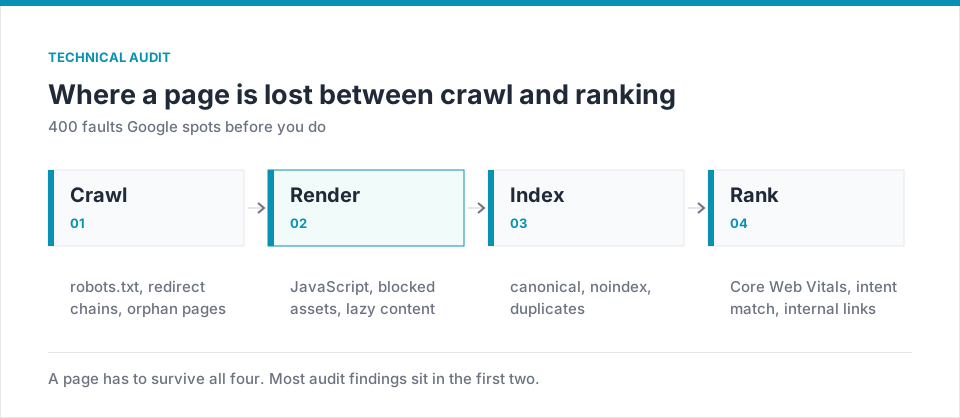
What the Semalt audit checks (in categories a marketer can defend)
Semalt’s audit engine runs more than four hundred checks per URL, grouped into ten categories a non-engineer can hand to a developer without translation:
Crawlability & indexation
robots.txt directives, XML sitemap validity, canonical loops, noindex conflicts, orphan pages, redirect chains longer than two hops, and the pages Google has crawled but never indexed.
Core Web Vitals
Field data pulled from Chrome UX Report for the last 28 days — LCP, INP (which replaced FID in March 2024) and CLS — on both mobile and desktop, per URL template rather than per single page.
Rendering & JavaScript
Every URL rendered in a headless Chromium at Googlebot resolution, comparing the raw HTML against the rendered DOM to catch content that only appears after client-side hydration.
Structured data
All JSON-LD, microdata and RDFa validated against the current Schema.org and Google rich-result specs, including Product, Recipe, LocalBusiness, HowTo, FAQ and Event.
Internal linking & architecture
PageRank flow modelled internally, orphan clusters flagged, click depth measured for every URL, and anchor-text distribution audited against the target keyword for each page.
On-page signals
Titles, meta descriptions, H1 uniqueness, image alt coverage, heading hierarchy, thin-content detection, cannibalisation between pages targeting the same keyword.
Mobile parity
Content, links and metadata compared between the mobile and desktop renders — Google switched to mobile-first indexing years ago, but 34% of the Liverpool sites we audit still ship different metadata on mobile.
Log-file analysis
Optional upload of nginx or Apache access logs to see exactly which URLs Googlebot spends its crawl budget on — nearly always different from what the sitemap claims is important.
Core Web Vitals in 2026: INP is the new LCP
Interaction to Next Paint replaced First Input Delay in March 2024, and the Merseyside sites we audit are still, in August 2026, failing it at a rate of roughly six in ten on mobile. The reason is almost always the same: too much JavaScript executing on the main thread during the first three seconds after page load. WordPress themes stuffed with page-builder scripts. Shopify apps that add 400ms of blocking work each. Squarespace templates loading fonts synchronously. The audit measures INP on the twenty-eighth percentile of your real users, not the synthetic Lighthouse score, and shows exactly which script is holding up the thread when the user first taps the menu.
Liverpool sites failing Core Web Vitals on mobile (audit sample, Q2 2026)
JavaScript rendering: where React and Vue quietly hide your content
The Baltic Triangle is full of small SaaS marketing sites built by developers who reached for Next.js the way earlier generations reached for jQuery. Client-side rendering is fine when you know what you are doing. Most of the time it is done in a hurry, and the result is a page whose primary content appears only after Googlebot has spent a rendering budget it does not necessarily have. Semalt’s audit renders every URL twice — raw HTML and post-hydration DOM — and shows you the delta. If your H1 and 60% of your body copy only exist after hydration, you are giving Google a shell of a page and hoping.
For the Wirral wedding venues, Woolton restaurants, and Widnes solicitors we onboard, the fix is typically not a rewrite. It is server-side rendering the pages that carry commercial intent, and leaving the rest client-side. The audit prioritises the twenty URLs where the render gap costs the most, so you fix twenty pages instead of two hundred. If you want to run the same check on your own domain, open a Semalt account and point the crawler at the sitemap.
Merseyside audit data 2026: On 68% of the Liverpool sites we audit, at least one primary landing page has a content-render gap of more than 40% between raw HTML and post-hydration DOM. Median revenue recovered after fixing the top ten: £3,400/month.
Structured data and the SERP features Merseyside sites keep losing
Google’s search result page in 2026 is barely a list of blue links anymore. It is a mosaic of rich results, AI overviews, People Also Ask boxes, Business Profile packs and product carousels. Every one of those slots is triggered by structured data on the page, and every one of them is worth two to five times a plain organic result in click-through. Semalt’s audit validates every JSON-LD block against the current Google rich-result spec, flags the pages where you are eligible for a feature you are not claiming, and shows the pages where you are claiming a feature you are not eligible for — which is worse, because Google demotes those.
For the typical Anfield-area hospitality group we audit, Recipe and Event schema are the two biggest missed opportunities. For Sefton Park guest houses it is LocalBusiness and Review. For a Bootle industrial-parts supplier it is Product and Offer. The audit surfaces each in a single ranked list.
The rich-result gap on Merseyside sites
The median Liverpool SME site is eligible for 4.2 rich-result types (based on content) and actively claims 0.9. Closing that gap alone typically adds 18-30% to organic CTR within six weeks, before any content or ranking work has begun.
Case study: Sefton Park guest house, 12 rooms, 400 checks
A twelve-room independent guest house near Lark Lane came to us in April 2026 with the following complaint: bookings via the website were down 44% year on year, but the property itself was busier than ever. The owner assumed a Google penalty. There was no penalty. There was a five-year accumulation of technical debt that Google had been quietly degrading them for. The Semalt audit landed in eighteen minutes and returned 397 findings across the ten categories. Ranked by revenue impact, the top ten were:
- Booking page LCP at 5.8 seconds on mobile (hero image 3.4MB, uncompressed).
- H1 present only after JavaScript hydration on twenty-two rooms pages.
- Duplicate LocalBusiness schema across three page templates, none of them valid.
- Canonical loop on the availability calendar generating 4,200 crawl requests a week for zero value.
- Robots.txt blocking the /amp/ directory (still referenced by twelve pages).
- Mobile hero image completely different from desktop; alt text missing on both.
- INP of 340ms on the “Book Now” button (third-party review widget blocking main thread).
- Sitemap listing 340 URLs; Google had indexed 44.
- Internal links to the “Rooms” page using six different anchor texts, none matching the target keyword.
- Two identical Review schema blocks on the homepage, one with malformed aggregateRating.
We handed the ranked list to a freelance developer in Kensington on the Monday. The top ten were resolved by the following Friday. Six weeks later, Search Console showed 62% more indexed URLs, 41% more organic clicks, and a booking conversion rate on the mobile site up from 0.9% to 2.1%. The owner has since stopped ringing us about the “penalty”.
“We’d spent two years assuming Google didn’t like us anymore. Turned out Google didn’t know what half our pages said, because the site was hiding them. The fix list was twelve pages long and my developer knocked it out in a week.”Owner, twelve-room guest house, Sefton Park
Semalt audit vs. Screaming Frog vs. Sitebulb vs. Ahrefs
Screaming Frog
£199/yr- Desktop-based crawler
- Extremely flexible
- Log analyser add-on
Gaps: no prioritisation, no revenue scoring, no scheduled monitoring.
Semalt Audit
From £0- 400+ checks per URL
- Impact scored in GBP
- Prioritised fix list
- Full JS rendering
- Monitored 24/7
- Integrated with AutoSEO
Ahrefs Site Audit
From £99/mo- Solid crawler
- Backlink context
- Scheduled crawls
Gaps: limited rendering depth, no revenue scoring, no fix execution.
| Capability | Semalt | Screaming Frog | Sitebulb | Ahrefs |
|---|---|---|---|---|
| Checks per URL | 400+ | ~150 | ~300 | ~140 |
| Full JavaScript rendering | ✓ | Optional | ✓ | Partial |
| Revenue-scored priority | ✓ | No | No | No |
| Scheduled 24/7 monitoring | ✓ | Manual | Scheduled | ✓ |
| Log-file analysis | Native | Add-on | Add-on | No |
| Direct fix execution (AutoSEO) | ✓ | No | No | No |
More in this series: The organic traffic GA4 hides from you, Push SEO changes live in 3 minutes, Watching Liverpool rivals, properly.
FAQ
How long does a first audit take?
A site with 500 URLs completes in about 18 minutes. A ten-thousand-URL site — a mid-sized Liverpool ONE tenant, say — runs overnight. Results appear as they come in, so the first prioritised faults are visible within minutes.
Do I need a developer to fix the findings?
For roughly 60% of the fixes on a typical Merseyside site, no — the Semalt AutoSEO module can push them live directly. For the remaining 40% (server config, template rewrites, image compression at scale) yes, but the ranked list means your developer is not guessing where to start. See the AutoSEO guide for what can be pushed without a developer.
Does it monitor after the first audit?
Yes. Sites are re-crawled on a schedule (daily, weekly or monthly depending on plan). Any regression is flagged the same day and emailed to the person you nominate — typically the marketing manager or the freelance developer on retainer.
Does it work for small sites?
Yes. A Wavertree solicitor with fifteen pages benefits as much as a Liverpool Waters redevelopment portal with three thousand. Small sites tend to have five to fifteen critical faults; fixing them typically doubles organic traffic within eight weeks.
How does it integrate with the rest of the Semalt platform?
Audit findings feed directly into the Analytics dashboard (so you see the traffic impact of each fault) and into AutoSEO (so the fixable ones can be pushed live from the same interface). Sign in and run an audit to see the loop in action.
A Liverpool site with three hundred unresolved technical faults will not out-rank a Manchester competitor with fifty, regardless of content or backlinks. The Semalt audit finds the faults, ranks them by revenue impact, and hands you a fix list your developer can actually work through.
Run your first audit
Point Semalt at your sitemap. Eighteen minutes later you have a ranked list of every technical fault Google can see. Whether the list has forty items or four hundred, at least you will know.
Sign in to Semalt Audit →