Contents
- The Liverpool vanity-volume trap
- Intent, priced properly: how the AI ranker works
- Semantic clusters, deduplication and the SERP overlap test
- Local nuance the big tools miss (Scouse, LFC, Wirral)
- Case study: Ropewalks bar & restaurant group, four venues
- Semalt Keyword AI vs. Ahrefs vs. Semrush vs. Keyword Planner
- FAQ
The Liverpool vanity-volume trap
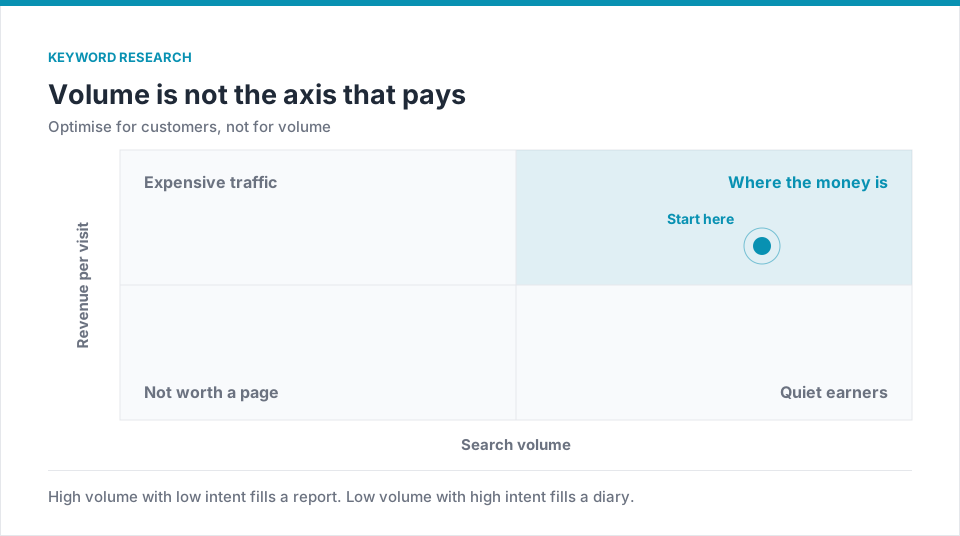
Every marketing agency on Merseyside has at some point delivered a keyword report where the top row said “restaurants Liverpool – 12,100 searches/month” and the client raised an eyebrow and asked, quite reasonably, why they had never converted from it. The answer is not that the term is fake. The answer is that the term is a directory query — people typing “restaurants Liverpool” are almost always about to click TripAdvisor, Google Maps or a Liverpool ONE listicle, and almost never about to book with an independent. The head keyword is a mirror. It shows the shape of demand but not the source of revenue.
The revenue — the actual bookings, the actual sales, the actual chartered-surveyor phone calls — sits in the long tail. “Late booking Ropewalks Friday”, “private dining room LFC European night”, “Southport wedding venue seats 120”, “dentist near Aigburth Vale opens Saturday”. Each of those has between 40 and 500 monthly searches. Each of them converts at 6-12% instead of 0.3%. And each of them is invisible to a keyword tool built by a US company that treats a 90-search term as noise.
Merseyside benchmark 2026: On the client sites we track, the top 5% of keywords by search volume drive 8% of bookings. The bottom 60% by search volume (all long-tail, all under 500 monthly searches) drive 71% of bookings. The industry has been optimising the wrong end of the curve for a decade.
Intent, priced properly: how the AI ranker works
Semalt’s AI keyword engine does not begin with volume. It begins with intent. Every keyword in the index is classified into one of four buckets by a model trained on eighteen million SERPs and roughly two million post-click conversion events pulled from consenting advertisers:
Navigational
The user already knows where they want to go. “LFC ticket office”, “Liverpool ONE opening hours”. Rarely worth optimising unless you are the brand.
Informational
The user wants to learn. “How to get from Lime Street to Anfield”. Excellent for authority and long-term trust, poor for near-term revenue.
Commercial
The user is comparing options. “Best steak restaurant Ropewalks”. This is where organic revenue is won or lost, and where Semalt spends the most of its scoring weight.
Transactional
The user is ready to buy or book. “Book table Duke Street tonight”. Highest CVR, usually lowest volume, always highest expected revenue per rank point.
Once every keyword is bucketed, Semalt multiplies its estimated CTR at your current position by a modelled conversion rate for that intent bucket, and then by the average order value or lead value in your vertical, to produce a Revenue Score in GBP. That score is what the shortlist ranks by. Not volume. Not KD. Not difficulty. Money.
Semantic clusters, deduplication and the SERP overlap test
A Liverpool copywriter briefed with a 400-line keyword list will write two articles at most before losing the will. The Semalt engine collapses long lists into semantic clusters using a SERP overlap test: if the top ten results for “steak restaurant Ropewalks” overlap by 60% or more with “best steakhouse Ropewalks”, they are the same target and belong on the same page. What was 400 lines becomes 38 clusters, each with a suggested page type (guide, listicle, service page, blog post), a target intent bucket, a Revenue Score and a suggested word count based on what the top three ranking pages actually publish.
For the typical Wirral wedding venue we onboard, that reduces “write 400 blog posts” (impossible, ignored) to “write 22 pages over the next quarter” (achievable, prioritised). If you want to see the same collapse on your own seed set, open a Semalt dashboard and drop in a starting phrase.
Why SERP overlap matters more than string similarity
“Cheap dentist Kensington” and “affordable dentist Kensington Liverpool” look almost identical to a keyword tool. Their SERPs share nine of ten results, so they are one cluster. Meanwhile, “emergency dentist Kensington” looks similar too, but its SERP shares only two of ten results with the first pair, because Google reads “emergency” as a completely different intent. That is a second cluster and needs its own page. String similarity alone cannot see the difference; SERP overlap can.
Local nuance the big tools miss (Scouse, LFC, Wirral)
Global keyword tools were built for global English. They tend to fold “Wirral” into “Liverpool”, misread “the Baltic” as the country not the neighbourhood, and quietly discard queries that mention specific streets or LFC matchdays as noise. Semalt’s Merseyside seed index carries roughly twelve thousand phrases that only make sense here, including:
Neighbourhood tails
- “dentist near Woolton Village”
- “solicitor Wavertree Road”
- “plumber Kirkdale L4”
- “Airbnb near Baltic Triangle”
- “guest house Sefton Park”
Event and season tails
- “restaurants near Anfield matchday”
- “Grand National weekend package Aintree”
- “Sound City afterparty venue”
- “Africa Oyé parking Sefton Park”
- “Christmas markets Liverpool ONE times”
Each of these low-volume tails is scored, ranked and clustered exactly the same way as a head term — which is why the Wirral wedding venue in the case study below out-earns a Manchester competitor with ten times the domain authority.
Case study: Ropewalks bar & restaurant group, four venues
A Ropewalks hospitality group with four venues between Bold Street and Duke Street came to us in March 2026 with a monthly SEO retainer they were about to cancel. The previous agency had delivered eighteen months of content optimising for “bars Liverpool”, “restaurants Liverpool” and “cocktails Liverpool”. Rankings had improved on all three, from page four to page two on average. Bookings had not moved.
We ran the Semalt keyword engine against the group’s core menu, opening hours and postcode. Three minutes later, the shortlist looked nothing like what the previous agency had produced:
- “Private dining room Ropewalks 12–20” — volume 90, Revenue Score £4,200/mo.
- “Late-night bar Bold Street kitchen open” — volume 170, Revenue Score £3,400/mo.
- “LFC pre-match food Duke Street” — volume 210, Revenue Score £2,900/mo.
- “Cocktail masterclass hen party Liverpool” — volume 320, Revenue Score £2,700/mo.
- “Christmas party venue Ropewalks 40 people” — volume 60 (seasonal), Revenue Score £6,100/mo (Dec).
None of these appeared in the top 200 of the previous agency’s list. Every one converted between 4x and 11x better than the head terms it had been chasing. We commissioned six pages against the top five clusters, published in the space of a fortnight, and pushed the on-page structure through AutoSEO without touching a developer. Twelve weeks later:
Ropewalks group, 12-week outcome
“We’d been paying for ‘restaurants Liverpool’ for a year and a half and it’d moved us up four places and made us no money. The new list looked ridiculous — sixty-search-a-month keywords — and it’s the only reason we’re not down two staff this quarter.”Operations Director, four-venue group, Ropewalks
Semalt Keyword AI vs. Ahrefs vs. Semrush vs. Keyword Planner
Google Keyword Planner
Free- Direct from Google Ads
- UK CPC ranges
- Grouped bands only
Gaps: broad volume bands, no intent classification, no revenue modelling.
Semalt Keyword AI
From £0- Ranked by GBP revenue
- 4-bucket intent classification
- SERP-overlap clustering
- Merseyside seed index
- Straight into AutoSEO
Ahrefs / Semrush
From £99/mo- Vast keyword database
- KD and traffic potential
- SERP feature tracking
Gaps: volume-first, no GBP revenue modelling, thin on UK long-tail.
| Capability | Semalt AI | Ahrefs | Semrush | Keyword Planner |
|---|---|---|---|---|
| GBP revenue score per keyword | ✓ | No | No | No |
| 4-bucket intent classification | ✓ | Partial | Partial | No |
| SERP-overlap clustering | ✓ | Limited | Limited | No |
| Merseyside local seed set | ✓ | Generic UK | Generic UK | Generic UK |
| Push directly to AutoSEO | ✓ | No | No | No |
The rule we run with our Liverpool content clients
Cap the head-term work at 20% of your content calendar. Spend the remaining 80% on commercial and transactional long-tail terms with a Revenue Score above £500/month. Over one full quarter, that ratio produces two to four times the bookings of a volume-led plan on the same budget.
FAQ
How does Semalt know the CPC and conversion rate in my vertical?
CPC is anchored to the current UK Google Ads market for every phrase, refreshed weekly. Conversion rate is modelled from two million anonymised conversion events across consenting advertisers, adjusted for your specific vertical and page type. The engine is transparent about the confidence interval on each Revenue Score — a Ropewalks bar with three months of tracking will have tighter intervals than a brand-new Woolton takeaway with none, and Semalt shows that uncertainty rather than hiding it in a headline number.
Does it work for seasonal Merseyside businesses?
Yes — the engine detects seasonal patterns in each phrase’s Search Console history and Google Trends data. A Southport tourism operator planning summer content in February will see Revenue Scores weighted toward July and August peaks rather than the flat monthly average that most tools default to.
Does it work for tiny local businesses?
Yes — a single-chair barber in Kensington runs the engine on a seed of “barber Kensington Liverpool” and gets a shortlist of 20-30 pages worth writing. Total content plan is usually finished in a weekend.
Does it work in Welsh, or for the Wrexham border?
The Merseyside seed index covers Cheshire, the Wirral and North Wales border. Welsh-language SERPs are supported but the volume there is thin; most cross-border Wrexham businesses target English-language searches from the M53 corridor.
Can I push the shortlist straight into content?
Yes. Each clustered page has a suggested brief (H1, H2s, target length, entities to cover) that can be sent to a copywriter as-is or opened in AutoSEO to auto-fill titles, meta descriptions and internal links on an existing page.
How does it link with the rest of the platform?
The keyword shortlist feeds Analytics (so you can see the revenue each cluster earns after publication) and Competitor Analysis (to see which clusters your Liverpool rivals are already claiming). Sign in and run your first shortlist to see the loop.
For Liverpool SEO in 2026, volume-led keyword research is a rounding error at best and a budget sink at worst. Semalt’s revenue-scored, intent-aware, SERP-overlap-deduplicated shortlist is what a monthly content plan should actually look like.
Try it on your seed keyword
Type in one starting phrase — “solicitor Wavertree”, “wedding venue Wirral”, “coffee Cavern Quarter” — and Semalt returns a ranked shortlist inside three minutes. Free, no card.
Sign in to Semalt Keyword AI →