Part 1 Of 15: What Is A Liverpool SEO Company And Why Local SEO Matters
Liverpool is a city of distinct neighbourhoods, thriving businesses, and a growing digital economy. For local firms aiming to attract nearby customers, partnering with a Liverpool SEO company isn’t just optional—it’s essential. Local search already dominates intent, with people in Liverpool turning to Google to find services within walking distance, from City Centre boutiques to Walton tradespeople and Anfield hospitality spots. A Liverpool-based SEO agency helps ensure your business appears precisely when and where potential customers are searching, across the surfaces that matter most in modern local search ecosystems.
What sets a credible Liverpool SEO company apart is not just technical know-how, but governance-informed discipline that keeps signals aligned as they diffuse across multiple surfaces. A robust local strategy starts with clean, consistent business data (the NAP signals), a geography-aware Local Page architecture, and a plan to translate proximity into action—directions, phone calls, visits, and ultimately conversions. The aim is to create a single, credible Topic Identity for your Liverpool business that travels across Local Pages, Google Maps overlays, Locale Hubs, Knowledge Graph Edges, Catalog entries, and Edge Experiences. This Part 1 outlines the case for a diffusion-led approach and how a Liverpool SEO partner can lay the groundwork for auditable growth from day one.
Local optimisation in Liverpool begins with clear anchor geographies. By identifying eight to twelve geography centres that reflect customer density and service opportunity, a Liverpool SEO company can publish diffusion briefs that define per-geography Local Pages, Maps attributes, and Locale Hub groupings. Translation parity travels with diffusion renders, so multilingual readers encounter identical geographic anchors across Local Pages, Maps overlays, and Knowledge Graph Edges, preserving a cohesive, city-wide identity.
In practice, the diffusion spine rests on six surfaces: Local Pages, Maps overlays, Locale Hubs, Knowledge Graph Edges, Catalog entries, and Edge Experiences. Governance artefacts ensure activation remains auditable as you scale, while diffusion dashboards give leadership a reliable view of health and progress across Liverpool districts such as City Centre, Anfield, and Southport-adjacent areas. A credible Liverpool SEO company will pair these governance foundations with practical activation templates and measurement controls you can reuse immediately.
Begin with eight to twelve geography anchors that reflect Liverpool’s market breadth. For each geography, publish a diffusion brief that defines per-surface content goals, Local Page structure, Maps attributes, and Locale Hub groupings. Translation parity travels with diffusion renders, so multilingual readers encounter identical geographic anchors across Local Pages, Maps overlays, and KG Edges, preserving a consistent Liverpool Topic Identity city-wide.
Concrete onboarding steps include establishing anchor geographies, publishing per-geography Local Page briefs, and maintaining a governance framework that records asset provenance and diffusion decisions. The objective is auditable growth: you can trace which Local Pages, Maps overlays, and Locale Hubs contributed to upticks in inquiries, while language parity remains intact across translations.
For teams ready to move from theory to practice, the Liverpool SEO Services hub on liverpoolseo.org offers activation briefs, governance templates, and diffusion dashboards you can reuse today. If you’d like tailored guidance, book a discovery call via the Liverpool contact page and start mapping geography to outcomes. External benchmarks such as Google Structured Data guidelines, Moz Local, and BrightLocal Local SEO ranking factors provide guardrails as you scale within Liverpool’s districts.
Part 1 establishes a governance-ready foundation. In Part 2, we translate these foundations into discovery and onboarding steps tailored to Liverpool, with anchor geographies, diffusion briefs, and the initial measurement controls you’ll need to track progress from day one. The goal is to create auditable pathways that leadership can trust while you scale across Liverpool’s diverse areas.
To begin applying these practices today, explore the Liverpool hub to access diffusion artefacts and per-surface briefs you can reuse. For tailored guidance, book a discovery call via the Liverpool contact page or browse the Liverpool SEO Services hub for artefacts you can implement immediately. External references such as Google Structured Data guidelines, Moz Local, and BrightLocal Local SEO ranking factors offer guardrails as you scale across Liverpool’s districts.
In summary, Part 1 lays the groundwork for a practical, governance-led diffusion approach within Liverpool. By defining anchor geographies, ensuring NAP hygiene, aligning per-surface data, and establishing auditable assets, a Liverpool SEO company can set the stage for measurable growth across Local Pages, Maps overlays, Locale Hubs, KG Edges, Catalog entries, and Edge Experiences.
Part 2 Of 15: Aligning SEO Goals With Your Liverpool Business Objectives
Building a successful Liverpool SEO programme starts with a clear line of sight from business outcomes to online visibility. A credible Liverpool SEO company does more than drive rankings; it translates your commercial goals into a diffusion plan that coordinates Local Pages, Maps overlays, Locale Hubs, Knowledge Graph Edges, Catalog entries, and Edge Experiences. This Part 2 focuses on setting meaningful targets, aligning expectations, and laying the governance groundwork that makes every improvement auditable and actionable for Liverpool-based organisations.
For Liverpool firms, success is best measured by quality of leads, revenue impact, and the real-world actions customers take as signals diffuse across surfaces. An effective Liverpool SEO plan begins by articulating business outcomes in terms that can be tracked across Local Pages, GBP, and Maps, then translating those outcomes into surface-specific targets. The aim is to create a single Liverpool Topic Identity that travels consistently from Local Pages to Locale Hubs and beyond, ensuring every surface contributes to the same overarching goal.
Key target areas commonly align with a business’s lifecycle stage: awareness, consideration, and conversion. By tying these stages to location-aware metrics, a Liverpool SEO company can demonstrate progress in terms that leadership understands, such as increases in store footfall, qualified inquiries, bookings, or average order value influenced by local visibility.
Adopt an eight-to-twelve geography framework to reflect Liverpool’s rich tapestry of districts. Typical anchors include City Centre, Walton, Anfield, Toxteth, Litherland, Crosby, Woolton, and Southport-adjacent corridors, with surrounding areas providing proximity signals as diffusion deepens. For each geography, publish a diffusion brief that links per-surface goals to Local Pages, Maps overlays, Locale Hubs, KG Edges, Catalog entries, and Edge Experiences. Translation parity travels with diffusion renders, preserving the same anchors across languages so Liverpool audiences experience a consistent Topic Identity.
A governance approach is essential to keep everyone aligned as the diffusion spine expands. ActivationTemplates should codify per-surface publishing rules, while a central Provenance Ledger records asset provenance, translations, and licensing terms. This ensures leadership can audit the diffusion path from Local Pages through to Maps overlays and Locale Hubs as new geographies join the spine.
To begin practical activation, visit the Liverpool SEO Services hub on liverpoolseo.org for activation briefs, per-surface artefacts, and governance templates you can reuse today. If you’d like tailored guidance, book a discovery call via the Liverpool contact page to map anchor geographies, diffusion depth, and governance cadence to your business priorities. External guardrails from Google Structured Data guidelines, Moz Local, and BrightLocal Local SEO ranking factors provide credible benchmarks as you scale across Liverpool’s districts.
2) Translating business goals into surface targets
Translate high-level business objectives into concrete surface targets. For example, a City Centre retailer may prioritise footfall and in-store conversions, while a suburban trades company might focus on quote requests and qualified inquiries from Local Pages. Map each objective to a diffusion spine so Local Pages contribute to Maps overlays, which in turn enhance Locale Hubs and KG Edges. Translation parity ensures multilingual audiences experience identical anchors and outcomes, safeguarding a unified Liverpool Topic Identity across languages.
Recommended target types include: percentage increases in Local Page visits, GBP interactions by geography, directions requests from Maps, and cross-surface conversions that tie back to revenue in your CRM. Establish realistic quarterly milestones and align them with a governance cadence that keeps leadership informed without creating friction or delay.
3) Onboarding and discovery steps for Liverpool
Begin with a discovery session to confirm eight to twelve anchor geographies and to define per-geography diffusion briefs. Ensure per-surface goals are specified for Local Pages, GBP, Maps overlays, Locale Hubs, KG Edges, Catalog entries, and Edge Experiences. This stage establishes the governance framework and ensures TranslationKeys parity travels with diffusion renders from day one.
- Define anchor geographies. Agree on the eight-to-twelve districts that reflect customer density and service opportunities in Liverpool.
- Publish diffusion briefs. Create per-geography briefs detailing surface-specific content goals, Maps attributes, and Locale Hub groupings.
- Establish governance cadence. Set review frequencies and dashboards to monitor diffusion health and alignment with business objectives.
From there, you can begin practical activation using the Liverpool hub’s artefacts and templates. Book a discovery call to tailor anchor geographies, diffusion depth, and governance cadence to your Liverpool footprint. External references remain valuable as guardrails, including Google Structured Data guidelines, Moz Local, and BrightLocal Local SEO ranking factors, which help calibrate diffusion health as you scale in Liverpool.
In summary, Part 2 outlines a practical, governance-based approach to aligning SEO goals with Liverpool business objectives. By defining geography anchors, publishing per-geography briefs, and establishing a clear governance cadence, you create auditable pathways that translate strategic aims into measurable outcomes across Local Pages, Maps overlays, Locale Hubs, KG Edges, Catalog entries, and Edge Experiences. Reuse activation artefacts from the Liverpool SEO Services hub and schedule a discovery call to tailor diffusion depth and governance cadence to your market footprint.
Part 3 Of 15: Core Pillars For Liverpool SEO
Liverpool’s local economy hinges on precise proximity signals that guide nearby customers from initial discovery to meaningful action. Building on the six-surface diffusion spine introduced in Part 1 and Part 2, a Liverpool-based SEO programme must couple governance with district-aware execution. The aim is to cultivate a single Liverpool Topic Identity that travels cleanly from Local Pages and Google Maps overlays to Locale Hubs, Knowledge Graph Edges, Catalog entries, and Edge Experiences. This Part 3 translates governance and diffusion principles into a practical Liverpool blueprint, outlining three essential pillars that align technical excellence, content localisation, and robust local presence to convert nearby searches into visits, calls, and conversations. For activation briefs, governance templates, and diffusion dashboards you can reuse today, visit the Liverpool SEO Services hub on liverpoolseo.org and book a discovery call via the Liverpool contact page.
The three pillars below are designed to reinforce a cohesive Liverpool Topic Identity as signals diffuse city-wide. They are implemented through ActivationTemplates, LocalizationManifest depth, TranslationKeys parity, LicensingStamp provenance, and a central Provenance Ledger so every surface remains aligned, auditable, and regulator-ready as you scale across districts like City Centre, Anfield, and South Liverpool.
1) Technical SEO foundations
Technical excellence anchors diffusion health. Prioritise a geography-aligned architecture that mirrors Liverpool’s anchor geographies, enabling Local Pages, Maps overlays, Locale Hubs, KG Edges, Catalog entries, and Edge Experiences to share a common structural backbone. A scalable canonical strategy prevents topic drift when content diffuses between surfaces and supports consistent localisation cues across languages. Per-surface structured data should reflect Liverpool geography as a coherent entity, with ongoing audits of data accuracy, indexation, and page speed across devices.
Practical steps include a recurring health check for crawlability, index coverage, and performance. Leverage Google’s guidance on structured data to validate per-surface schema quality, while cross-referencing local benchmarks from Moz Local and BrightLocal to ensure surface health scales with Liverpool’s growth.
- Geography-aligned crawlable hierarchy. Create dedicated hubs per geography that feed six surfaces with stable, readable URLs reflecting Liverpool anchors.
- Cross-surface canonical relationships. Tie related pages back to geography anchors to avoid topic drift and cross-surface cannibalisation.
- Per-surface structured data. Deploy LocalBusiness, Service, and Product schemas that articulate the geography and services for Local Pages, Maps overlays, Locale Hubs, and KG Edges.
- Language parity across surfaces. Ensure TranslationKeys parity travels with diffusion renders so multilingual readers encounter identical geographic anchors across Local Pages, Maps overlays, and KG Edges.
2) Content strategy and localisation framework
Content should tie local Liverpool intent to actionable outcomes. Build district-focused topic families that originate on Local Pages and diffuse into Locale Hubs, Maps overlays, KG Edges, Catalog entries, and Edge Experiences. A disciplined content calendar aligned with city events, neighbourhood life, and service opportunities keeps content timely and locally relevant. Translation parity travels with diffusion renders, ensuring multilingual readers encounter the same geographic anchors across surfaces. Include district-specific case studies, neighbourhood FAQs, and service pages that reflect Liverpool’s distinctive communities and business needs.
District briefs should guide per-surface content creation, with a clear map from geography to Local Page, to Map, to Hub, and to KG Edge. This approach preserves a single Liverpool Topic Identity even as content expands into adjacent districts such as Anfield, Walton, and South Liverpool, maintaining language parity throughout.
- District-focused calendars. Plan FAQs, service descriptions, and visuals tied to Liverpool districts.
- Local knowledge graph signals. Link Local Pages to nearby venues, landmarks, and partners to strengthen city-wide relevance.
- Translation governance. Ensure TranslationKeys parity travels with diffusion renders so multilingual readers encounter identical anchors.
3) Local presence and Google Business Profile hygiene
Google Business Profile (GBP) remains the digital storefront that seeds diffusion signals across Local Pages and Maps overlays. Maintain a consistent business name, address, and phone (NAP) across Local Pages and GBP, with verified hours and service areas that reflect real-world Liverpool operations. Proactively manage reviews to reinforce proximity signals and update GBP content to reflect district-specific offerings. Translation parity travels with diffusion renders so multilingual readers encounter identical geographic anchors on GBP, Local Pages, and Maps overlays.
ActivationTemplates should codify how GBP information translates to Local Pages and Maps overlays, enabling consistent district anchors city-wide. Governance dashboards support regulator-ready reporting as signals diffuse, while Google’s Structured Data guidelines provide guardrails to ensure GBP data remains authoritative. For practical enablement, apply activation briefs from the Liverpool hub and align with TranslationKeys parity so multilingual readers see identical geographic anchors across surfaces.
In practice, ensure a well-defined process for NAP harmonisation, district-specific GBP posts, and regular review cycles. A central Provenance Ledger records asset provenance and translation status, ensuring diffusion remains auditable as Liverpool expands into additional geographies such as Walton, Crosby, and Woolton. External benchmarks from Google Structured Data guidelines, Moz Local, and BrightLocal Local SEO ranking factors provide guardrails as you scale.
Measurable progress hinges on a clear governance cadence. ActivationTemplates codify per-surface publishing rules; TranslationKeys parity protects language consistency; LicensingStamp provenance tracks asset rights; and a central Provenance Ledger logs diffusion movements for regulator-ready reporting. For practical enablement, explore the Liverpool SEO Services hub for activation briefs and governance artefacts you can reuse today, and book a discovery call via the Liverpool contact page to tailor anchor geographies, diffusion depth, and governance cadence to your market footprint.
In summary, Part 3 delivers a practical, governance-backed framework for Liverpool: three pillars that fuse technical excellence, localisation depth, and robust local presence. With ActivationTemplates, LocalizationManifest depth, TranslationKeys parity, LicensingStamp provenance, and a central Provenance Ledger, your Liverpool presence can grow with clarity, auditability, and measurable ROI as signals diffuse across Local Pages, Maps overlays, Locale Hubs, KG Edges, Catalog entries, and Edge Experiences. To access ready-to-use artefacts and per-surface briefs you can reuse today, visit the Liverpool SEO Services hub and book a discovery call to tailor the diffusion spine to your geographic footprint: SEO Services hub and Liverpool contact page.
Part 4 Of 15: What A Typical Liverpool SEO Service Package Includes
A credible Liverpool SEO company delivers more than technical fixes; it packages a holistic, governance-driven programme that aligns with the six-surface diffusion spine introduced in Parts 1–3. A typical Liverpool SEO service package from liverpoolseo.org includes core components such as comprehensive audits, technical optimisation, on-page and content strategy, localisation for Liverpool districts, GBP hygiene, link building and digital PR, reputation management, and ongoing analytics. Every activity is designed to reinforce a single Liverpool Topic Identity as signals diffuse across Local Pages, Google Maps overlays, Locale Hubs, Knowledge Graph Edges, Catalog entries, and Edge Experiences. ActivationTemplates, TranslationKeys parity, LicensingStamp provenance, and a central Provenance Ledger ensure auditable governance from day one.
1) Comprehensive site audit and discovery. We begin with a discovery workshop to confirm eight to twelve anchor geographies that reflect Liverpool’s market density and service opportunities. Deliverables include per-geography diffusion briefs, surface-specific goals for Local Pages, GBP, Maps overlays, Locale Hubs, KG Edges, Catalog entries, and Edge Experiences, plus a governance plan that records asset provenance and diffusion decisions. This initial audit also benchmarks against local authorities’ expectations and external standards to set a credible baseline for diffusion health across the Liverpool footprint.
From the outset, you receive activation briefs and governance templates you can reuse. A Liverpool hub provides diffusion artefacts that align with your business priorities, and you can book a discovery call via the Liverpool contact page to tailor anchor geographies and diffusion depth to your market.
2) Technical SEO foundations and architecture
Geography-aligned architecture underpins diffusion health. Establish a scalable hub-and-spoke structure for each geography that feeds six surfaces with stable, geography-rich entry points. Implement a cross-surface canonical strategy to prevent topic drift, and ensure per-surface structured data reflects Liverpool geography as a coherent entity. Language parity travels with diffusion renders, so translations stay aligned with anchors across Local Pages, GBP, Maps overlays, Locale Hubs, KG Edges, Catalog entries, and Edge Experiences.
Key technical steps include crawlability and indexability audits, page speed optimisation, and consistent schema deployment. Leverage Google’s guidelines for structured data and cross-reference local benchmarks from Moz Local and BrightLocal to maintain surface health as Liverpool grows.
3) Local presence, GBP hygiene and local signals
Google Business Profile remains a digital storefront that seeds diffusion across Local Pages and Maps overlays. Maintain a consistent NAP across Local Pages and GBP, with district-aware hours and area coverage that mirrors real-world Liverpool operations. Proactively publish district-specific GBP posts and keep GBP content aligned with Local Pages to reinforce proximity signals city-wide. Translation parity travels with diffusion renders, ensuring multilingual readers encounter identical anchors on GBP and across surfaces.
Activation templates codify how GBP data translates to Local Pages and Maps overlays, while governance dashboards provide regulator-ready reporting on diffusion health. Tap into the Liverpool hub for activation briefs and per-surface artefacts, and book a discovery call to tailor anchors, diffusion depth, and governance cadence to your Liverpool footprint.
4) On-page optimisation and content strategy
Content strategy should tie Liverpool intent to actionable outcomes. Develop district-focused topic families that originate on Local Pages and diffuse into Locale Hubs, Maps overlays, KG Edges, Catalog entries, and Edge Experiences. A disciplined content calendar, aligned with city events and neighbourhood life, ensures relevance across Liverpool districts such as City Centre, Anfield, Walton, and South Liverpool. Translation parity travels with diffusion renders so multilingual readers encounter identical geography anchors across surfaces.
Practical activations include district-specific FAQs, service pages, and case studies that reflect Liverpool’s communities. A clear map from geography to per-surface content goals keeps the Liverpool Topic Identity cohesive as diffusion expands.
5) Link building and digital PR for Liverpool
Earn high-quality, geography-relevant links that reinforce proximity signals. Local content-led PR, community partnerships, and event-driven outreach anchor to geography-backed assets such as Local Pages and Locale Hubs. ActivationTemplates govern where links appear across surfaces to maintain a single Liverpool Topic Identity, while a central Provenance Ledger traces asset provenance, translations, and licensing terms for regulator-ready reporting.
External benchmarks from Google Structured Data guidelines, Moz Local, and BrightLocal Local SEO ranking factors provide guardrails as you scale. Each earned link should relate to a Liverpool geography and surface to ensure diffusion signals remain cohesive city-wide.
6) Reputation management and reviews
Reviews and testimonials act as local proof points that strengthen proximity signals across six surfaces. Implement a district-aware reviews programme that collects authentic feedback from Liverpool customers and feeds Local Page briefs and Maps overlays. Prompt responses to reviews reinforce trust signals, while translation parity ensures multilingual readers see consistent anchors and outcomes.
Governance artefacts track review provenance, translation status, and licensing considerations, ensuring regulator-ready reporting as content diffuses city-wide.
7) Analytics, dashboards and reporting
Measurement across the diffusion spine relies on a Diffusion Health Index (DHI) that blends engagement, proximity fidelity, and asset provenance. Dashboards provide city-wide visibility of cross-surface activity, helping Liverpool leadership understand how proximity signals translate into inquiries, bookings, and store visits. Tie MDHI or DHI metrics to business outcomes and maintain translation parity and provenance data within the central ledger for auditable, regulator-ready reporting.
Read next: SEO expert Liverpool: local and global · Liverpool SEO consultant: the ROI
To apply these patterns now, visit the Liverpool SEO Services hub for ready-to-use activation briefs and governance artefacts you can reuse today. If you’d like tailored guidance, book a discovery call via the Liverpool contact page to align anchor geographies, diffusion depth, and governance cadence with your market footprint.
External references for credibility include Google Structured Data guidelines, Moz Local, and BrightLocal Local SEO ranking factors to calibrate diffusion health as Liverpool grows: Google Structured Data guidelines, Moz Local, and BrightLocal Local SEO ranking factors.
In summary, Part 4 outlines a practical Liverpool service package that combines audits, technical excellence, local optimisation, content depth, and governance to deliver auditable, repeatable diffusion across Local Pages, Maps overlays, Locale Hubs, KG Edges, Catalog entries, and Edge Experiences. Access activation artefacts on the Liverpool hub and book a discovery call to tailor diffusion depth and governance cadence to your Liverpool footprint.
Part 5 Of 15: SEO Audit — The Foundation For Liverpool SEO Performance
A thorough Liverpool SEO audit is the engine that informs every subsequent diffusion across Local Pages, Maps overlays, Locale Hubs, Knowledge Graph Edges, Catalog entries, and Edge Experiences. By diagnosing crawlability, indexation, user experience blockers, and content gaps, a Liverpool-based SEO programme can prioritise the right activations, ensure language parity, and maintain a single Liverpool Topic Identity as signals diffuse city-wide. This Part 5 translates governance concepts into actionable audit steps, grounding improvements in measurable, surface-aligned outcomes. For activation briefs, governance templates, and diffusion dashboards you can reuse today, visit the Liverpool hub on liverpoolseo.org and book a discovery call via the Liverpool contact page.
A geography-aligned audit starts with eight to twelve Liverpool anchors that reflect customer density and service opportunity: City Centre, Anfield, Walton, Everton, Toxteth, Crosby, Bootle, Litherland, Skelmersdale as a regional reference point, and nearby suburbs that feed diffusion depth. Each geography should have a dedicated diffusion hub that feeds Local Pages, Maps overlays, Locale Hubs, KG Edges, Catalog entries, and Edge Experiences. This anchor set anchors the six-surface diffusion spine and keeps a consistent Topic Identity as signals move through each surface.
1) Comprehensive site health checks for Liverpool anchor geographies
Perform a crawlability and indexability health check at the geography level. Ensure per-geography Local Pages are discoverable, crawlable, and properly linked to their Maps overlays and Locale Hubs. Validate that canonical relationships reflect geography anchors and avoid topic drift when content diffuses across surfaces. Confirm that per-surface structured data (LocalBusiness, Service, Product) is present and coherent with the geography, so search engines understand the local entity network. Translation parity should travel with diffusion renders, ensuring multilingual readers encounter identical geography anchors across Local Pages, Maps overlays, and KG Edges.
- Crawlability and indexation health. Run geography-focused crawls to verify all Local Pages, Maps overlays, and Locale Hubs are indexable and properly linked.
- Canonical integrity per geography. Establish stable canonical relationships so Local Pages remain the authority for their geography, with Maps overlays and Locale Hubs referencing that authority.
- Per-surface schema alignment. Deploy LocalBusiness, Service, and Product schemas that reflect geography and services, connected to KG Edges and Edge Experiences.
- Language parity and translation readiness. Ensure TranslationKeys parity travels with diffusion renders across all six surfaces.
ActivationTemplates should codify per-surface publishing rules and per-geography diffusion briefs. A central Provenance Ledger records asset provenance, translations, and licensing terms, enabling regulator-ready reporting as Liverpool expands into additional geographies. Practical health checks also verify page speed, mobile performance, and secure connections across Local Pages and diffusion surfaces. For guardrails, leverage Google Structured Data guidelines, Moz Local, and BrightLocal Local SEO ranking factors to maintain surface health as Liverpool grows.
2) Competitor analysis and opportunities
Map Liverpool competitors by geography and surface to understand how nearby businesses attract proximity signals. Assess what Local Pages, Maps overlays, Locale Hubs, KG Edges, Catalog entries, and Edge Experiences your rivals are activating, and identify gaps where your diffusion spine can gain traction. Use diffusion dashboards to compare surface-level health and identify quick wins that can be implemented within days, and longer-term openings that may require cross-department collaboration. Translation parity remains essential so rival activity doesn’t create language drift across surfaces.
- Geography-specific competitive mapping. Catalogue top local competitors for each anchor geography and surface.
- Surface health benchmarking. Compare Local Pages, GBP, Maps overlays, Locale Hubs, KG Edges, Catalog entries, and Edge Experiences against peers.
- Opportunity prioritisation. Rank quick wins (NAP hygiene, GBP updates, local schema) against long-term investments (diffusion briefs, governance cadences, translation parity).
External references to guardrails support implementation: Google Structured Data guidelines, Moz Local, and BrightLocal Local SEO ranking factors. For practical enablement, access the Liverpool hub for activation briefs and governance artefacts you can reuse today, and book a discovery call to tailor diffusion depth and governance cadence to your local footprint.
3) Quick wins versus longer-term opportunities
Prioritise quick wins that stabilise the diffusion spine and improve immediate surface signals, while planning longer-term governance enhancements that sustain Topic Identity as Liverpool geography expands. Quick wins include GBP hygiene coordination, Local Page updates with district qualifiers, and robust cross-surface canonical decisions. Longer-term opportunities focus on eight-to-twelve anchor geographies, diffusion cadences, and continuous auditing against the Provenance Ledger. Translation parity should accompany all diffusion renders to ensure language consistency across Local Pages, Maps overlays, Locale Hubs, and KG Edges.
Commit to a practical activation calendar and governance cadence. Use ActivationTemplates to codify per-surface publishing rules, LocalizationManifest depth to cap diffusion, and LicensingStamp provenance to track asset rights. A Diffusion Health Index (DHI) dashboard should be used to monitor cross-surface engagement, proximity signals, and asset provenance so leadership can articulate a clear ROI narrative as Liverpool grows.
To apply these patterns now, visit the Liverpool SEO Services hub for ready-to-use artefacts and per-surface briefs you can reuse today. For tailored guidance, book a discovery call via the Liverpool contact page to map anchor geographies, diffusion depth, and governance cadence to your market footprint. External references such as Google Structured Data guidelines, Moz Local, and BrightLocal Local SEO ranking factors provide guardrails as you scale within Liverpool’s districts.
In summary, Part 5 provides a practical Liverpool-specific audit framework that grounds the diffusion spine in crawlability, indexation, competitor insight, and governance. By validating geometry anchors, ensuring cross-surface canonical integrity, and enforcing TranslationKeys parity, Liverpool teams create auditable, scalable foundations for Local Pages, Maps overlays, Locale Hubs, KG Edges, Catalog entries, and Edge Experiences. To begin deploying these audit patterns now, access ActivationTemplates and governance artefacts in the Liverpool hub and book a discovery call to tailor diffusion depth and governance cadence for your footprint: Liverpool SEO Services hub and Liverpool contact page.
Part 6 Of 15: On-page Optimisation And Content Strategy
Following the SEO audit, this part translates insights into practical on-page optimisation and a district-aware content strategy for Liverpool. The goal remains a single Liverpool Topic Identity that travels neatly from Local Pages and Google Maps overlays to Locale Hubs, Knowledge Graph Edges, Catalog entries, and Edge Experiences. By structuring content, metadata, and internal pathways around Liverpool’s anchor geographies, you unlock higher relevance, improved user experience, and measurable conversions as signals diffuse across six surfaces.
Begin with geography-aligned seed keywords that reflect genuine local intent. For each anchor geography, capture core services, district qualifiers, and common questions. Practical Liverpool seeds include City Centre SEO, Anfield local services, Walton proximity queries, Toxteth area solutions, and Crosby neighbourhood optimisations. These seed clusters feed Local Pages and Maps overlays, ensuring every surface centres on the same geography anchors as diffusion progresses city-wide. Translation parity travels with diffusion renders so multilingual readers encounter identical geographic anchors across Local Pages, Maps overlays, and KG Edges, safeguarding a cohesive Liverpool Topic Identity.
1) Define eight to twelve anchor geographies and capture district intents
Eight to twelve anchors provide the density needed for robust proximity signals and reliable Local Page discovery. In Liverpool, practical anchors include City Centre, Anfield, Walton, Toxteth, Litherland, Crosby, Woolton, Knotty Ash, Kensington, and Southport-adjacent corridors, with surrounding areas feeding diffusion depth. For each geography, document primary search intents: services requested, local events, and nuanced service-area considerations. The diffusion briefs then prescribe per-surface keywords and content focus for Local Pages, Maps overlays, Locale Hubs, KG Edges, Catalog entries, and Edge Experiences. Translation parity travels with diffusion renders, so multilingual readers encounter identical geography anchors across surfaces.
2) Build a diffusion-ready keyword taxonomy across six surfaces
Develop a taxonomy that supports Local Pages, Locale Hubs, Maps overlays, KG Edges, Catalog entries, and Edge Experiences. For each geography, align surface-specific keywords to the diffusion spine. Examples include:
- Local Pages: Liverpool City Centre SEO agency, City Centre local SEO Liverpool, Liverpool city centre service area.
- Maps overlays: City Centre directions, Liverpool proximity services near me, City Centre near me Liverpool.
- Locale Hubs: City Centre neighbourhood guide, City Centre events, Liverpool City Centre local references.
Per-surface schemas reinforce Knowledge Graph relationships while TranslationKeys parity travels with diffusion renders, ensuring language variants stay anchored to the same geography across surfaces. This cohesion is essential for sustained proximity signals that travel from Local Pages to Maps overlays and beyond.
3) Local intent signals and district qualifiers
Local intent is sharpened by district qualifiers and proximity modifiers. Craft geography-aware content briefs that channel district-specific questions, services, and events into Local Pages, Maps overlays, and Locale Hubs. Use wording that reads naturally while preserving a cohesive Liverpool Topic Identity as signals diffuse across surfaces.
- Proximity phrases: near me, in Liverpool, around City Centre.
- District-specific questions: best Liverpool SEO agency, local services in Anfield.
- Event-driven terms: Liverpool festival, local market, community event.
4) Translation parity and language considerations
Liverpool’s communities are diverse. When multilingual content serves anchor geographies, ensure TranslationKeys parity travels with diffusion renders so language variants stay anchored to the same geographies. Plan for commonly used languages in Liverpool communities—Polish, Urdu, Punjabi, Bengali, and Chinese—and apply language-aware metadata and per-surface structured data to signal language and geography to search engines. Where relevant, embed bilingual content into Local Pages and Maps overlays to support local trust and accessibility while preserving Topic Identity across surfaces.
5) Activation and measurement readiness
Turn insights into action. Feed geography-specific keywords into per-surface briefs, Local Pages, and Maps overlays, then monitor diffusion health through a Diffusion Health Index (DHI) that blends engagement, proximity fidelity, and asset provenance. Use diffusion dashboards to review progress and adjust diffusion depth as you expand into additional districts. For credible benchmarks, reference Google Structured Data guidelines, Moz Local, and BrightLocal Local SEO ranking factors.
To apply these practices now, visit the Liverpool SEO Services hub for diffusion artefacts and per-surface briefs you can reuse. If you’d like tailored guidance, book a discovery call via the Liverpool contact page to align anchor geographies, diffusion depth, and governance cadence with your business priorities. External references such as Google Structured Data guidelines, Moz Local, and BrightLocal Local SEO ranking factors provide guardrails as you scale within Liverpool’s districts.
In summary, Part 6 delivers a practical, evidence-based approach to on-page optimisation and content strategy tailored to Liverpool. By defining anchor geographies, building a diffusion-ready keyword taxonomy, enforcing TranslationKeys parity, and measuring diffusion health across six surfaces, you create a scalable foundation for local visibility and conversions. For ready-to-use artefacts and activation briefs, explore the Liverpool SEO Services hub on liverpoolseo.org and book a discovery call via the Liverpool contact page to tailor these patterns to your geographic footprint. External benchmarks from Google Structured Data guidelines, Moz Local, and BrightLocal Local SEO ranking factors offer guardrails as you scale across Liverpool.
Part 7 Of 15: Link Building And Digital PR In Liverpool
In Liverpool’s six-surface diffusion framework, high-quality links and credible local digital PR are not optional add-ons. They act as authoritative signals that reinforce a single Liverpool Topic Identity as signals move from Local Pages and Google Maps overlays to Locale Hubs, Knowledge Graph Edges, Catalog entries, and Edge Experiences. This Part 7 translates governance-led diffusion concepts into practical, district-focused link-building and PR playbooks that stay ethical, relevant, and auditable across Liverpool’s neighbourhoods—from City Centre to Anfield, Walton to Crosby. All activities align with ActivationTemplates, TranslationKeys parity, LicensingStamp provenance, and a central Provenance Ledger so diffusion remains transparent city-wide.
1) Local link-building fundamentals in Liverpool
Quality links, not sheer volume, drive durable local authority. In Liverpool, links anchored to districts like City Centre, Anfield, Walton, Toxteth, Litherland, Crosby, and Woolton travel with a consistent geography, strengthening the Liverpool Topic Identity as signals diffuse to Locale Hubs and KG Edges. ActivationTemplates guide where external references may appear and ensure every link reinforces geography anchors rather than fragmenting the topic.
Key principle: relevance, proximity, and context. A district-focused link should accompany a Local Page brief or a Locale Hub asset to preserve a coherent signal path from surface to surface. Translation parity travels with diffusion renders so multilingual readers encounter identical geography anchors across Local Pages, Maps overlays, and KG Edges.
2) Six practical link-building tactics for Liverpool
Local content-led PR: Create district-focused case studies, guides, and resource pages that naturally attract coverage from Liverpool outlets and industry sites. Each earned link should reference a Local Page or Locale Hub to maintain Topic Identity across surfaces.
- Local content-led PR. Publish district-specific resources editors want to reference, then pitch them to Liverpool publications for contextual backlinks.
- Community and business partnerships. Build co-authored content with Liverpool institutions, venues, and associations to gain authoritative, geographically anchored links.
- Event-driven outreach. Sponsor or host local events and secure coverage with links to dedicated Local Pages or Maps overlays, ensuring diffusion remains geography-aligned.
- Resource hubs and evergreen guides. Develop district-specific resource hubs that link to Local Pages and Locale Hubs, increasing natural backlink opportunities from nearby organisations.
- Editorial outreach with value. Pitch data-backed stories or expert commentary relevant to Liverpool districts, attaching a diffusion brief and offering translations to protect TranslationKeys parity.
- Local citations with governance controls. Expand high-quality citations across district directories and media sites, ensuring NAP consistency and per-surface metadata alignment to protect Topic Identity across Local Pages and Maps overlays.
Resource hubs and evergreen guides: Build district-specific resource hubs (for example, a Liverpool service-area hub) that attract natural backlinks from nearby organisations and community sites. Editorial outreach with value: Pitch data-backed stories or expert commentary relevant to Liverpool districts, attaching a diffusion brief and offering translations to preserve TranslationKeys parity across languages. Local citations with governance controls: Expand high-quality citations across district directories and media sites, ensuring NAP consistency and per-surface metadata alignment to protect Topic Identity across surfaces.
3) Digital PR in Liverpool: relevance, scale, and ethics
Digital PR in Liverpool should be data-informed and locality-aware. Use press releases, data visualisations and thought-leadership pieces that resonate with Notable districts such as City Centre and Anfield, while ensuring links point to geography-backed assets. ActivationTemplates should codify where links appear across six surfaces so they reinforce a unified Liverpool Topic Identity rather than creating fragmented clusters.
Governance handrails, including a central Provenance Ledger and LicensingStamp provenance for media assets, ensure rights and usage terms travel with diffusion. External benchmarks from Google Structured Data guidelines, Moz Local, and BrightLocal Local SEO ranking factors help calibrate surface health as Liverpool grows.
In practice, ensure a well-defined process for linking GBP and Local Page content to district-led PR stories. A central Provenance Ledger records asset provenance and translation status, ensuring diffusion remains auditable as Liverpool expands into additional geographies such as Walton, Crosby, and Woolton. External references from Google Structured Data guidelines, Moz Local, and BrightLocal Local SEO ranking factors provide guardrails as you scale.
4) Governance, translation, and provenance in links
Translation parity travels with diffusion renders, so language variants maintain identical geography anchors when links are published or cited. Licensing terms attached to media assets must travel with the diffusion path, ensuring regulator-ready reporting. ActivationTemplates should embed per-surface publishing rules, and per-geography diffusion briefs must specify how links appear within Local Pages, Maps overlays, and Locale Hubs. This preserves a single Liverpool Topic Identity even as new geographies join the diffusion spine.
5) Measuring link quality and diffusion impact
A Diffusion Health Index (DHI) captures cross-surface link impact on engagement, proximity signals, and conversions. Track link velocity, editorial relevance, and downstream effects on Local Page visits, GBP interactions, and Maps directions. Use diffusion dashboards to monitor progress and tie backlink activity to tangible outcomes and revenue movements. External references such as Moz Local and BrightLocal Local SEO ranking factors provide guardrails as you scale within Liverpool.
6) Getting started today: activation briefs and practical roadmap
Audit your current backlink portfolio for Liverpool relevance and geography alignment. Identify eight to twelve anchor geographies and craft per-geography diffusion briefs that specify Local Page goals, per-surface schema, and translation requirements. Populate ActivationTemplates with per-surface publishing rules and establish a central Provenance Ledger to record asset provenance and diffusion decisions. To accelerate enablement, book a discovery call via the Liverpool contact page and access diffusion artefacts and governance templates you can reuse immediately. External references like Google Structured Data guidelines, Moz Local, and BrightLocal Local SEO ranking factors offer guardrails as you scale across Liverpool’s districts.
To apply these practices now, explore the Liverpool hub for activation briefs and governance artefacts you can reuse today, and schedule a discovery call to tailor anchor geographies, diffusion depth, and governance cadence to your footprint: Liverpool SEO Services hub and Liverpool contact page.
Part 8 Of 15: Local Authority And Trust Signals For Liverpool SEO
Trust signals sit at the heart of Liverpool’s diffusion framework. They connect user perception with tangible actions across Local Pages, Google Maps overlays, Locale Hubs, Knowledge Graph Edges, Catalog entries, and Edge Experiences. A credible Liverpool SEO company builds authority city-wide by aligning reviews, testimonials, social proof, local citations, and licensing provenance within a governance-enabled spine. ActivationTemplates and a central Provenance Ledger ensure every signal travels with clear provenance, language parity, and regulator-ready reporting asLiverpool amplifies proximity signals across districts from City Centre to Anfield and Walton.
Establishing a district-aware reviews programme is the starting point. Authentic feedback collected across Liverpool’s core geographies informs Local Page briefs and Maps overlays, enriching the diffusion spine with lived experiences. Publishing thoughtful responses demonstrates accountability and translates feedback into improved local service delivery. Translation parity travels with diffusion renders so multilingual readers encounter identical anchors and outcomes across Local Pages and GBP, upholding a cohesive Liverpool Topic Identity as signals diffuse city-wide.
1) Reviews strategy: acquisition, response, and leverage
- Solicit context-rich reviews. Encourage clients to mention district-specific landmarks, transport routes, or local service nuances to deepen relevance on Local Pages and GBP.
- Respond promptly and constructively. Implement a standard response framework that acknowledges feedback, showcases district-specific benefits, and directs readers to the most relevant Local Page or Locale Hub.
- Diffuse positive sentiment city-wide. Use high-scoring reviews to seed Local Page briefs and Maps overlays, ensuring TranslationKeys parity so language variants reflect identical anchors.
Public guidance from Google on reviews helps calibrate expectations and ensure reviews contribute to credibility without manipulating rankings. Pair reviews with per-surface structured data to improve eligibility for local rich results and to strengthen connections with KG Edges that tie businesses to Liverpool communities.
2) Testimonials and case studies: credibility at scale
Transform customer stories into district-focused assets that live on Local Pages, Locale Hubs, and Map overlays. Develop district-specific case studies that demonstrate outcomes in City Centre, Anfield, and South Liverpool, illustrating tangible value for local residents and businesses. Translation-aware assets preserve a coherent anchor across languages, while ActivationTemplates specify where testimonials appear and how they link back to geography anchors that started the diffusion.
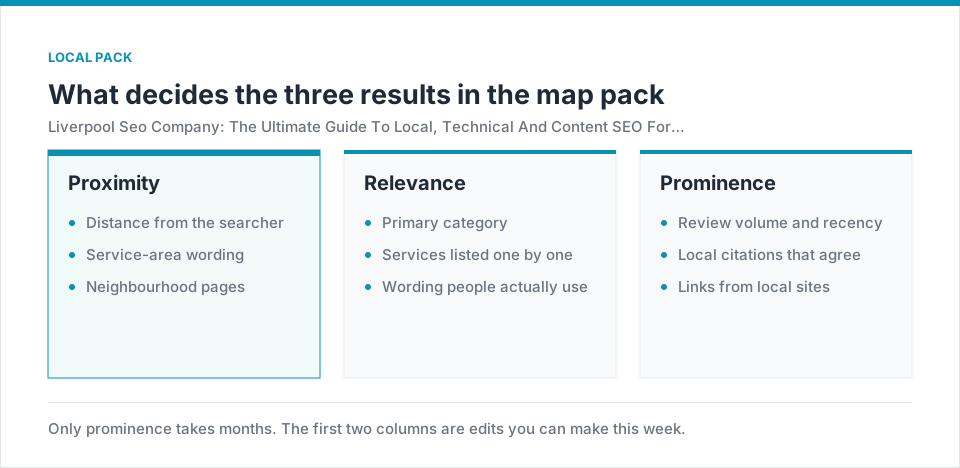
Governance artefacts log asset provenance, translation status, and licensing terms, ensuring regulator-ready reporting as content diffuses to KG Edges and Locale Hubs. When publishing multilingual case studies, maintain TranslationKeys parity so readers in Toxteth or Litherland see the same geography anchors and outcomes in their language. This consistency supports the perception of a single Liverpool Topic Identity across surfaces.
3) Social proof and channel synergy
Social proof magnifies proximity signals when aligned with the diffusion spine. Integrate district-focused social highlights—success metrics, community events, and partner recognitions—into Local Pages and Maps overlays to reinforce trust without causing surface drift. Ensure cross-surface messaging remains consistent with the Liverpool Topic Identity and that translations reflect identical anchors across languages.
Measurement should capture sentiment lift, engagement with trust signals, and downstream conversions. A Diffusion Health Index (DHI) can blend review quality, testimonial engagement, and case-study traffic to provide a holistic view of trust-building progress across all surfaces. External benchmarks from Google Structured Data guidelines, Moz Local, and BrightLocal Local SEO ranking factors provide guardrails as you scale trust signals city-wide.
4) Local citations, authority signals, and licensing provenance
High-quality local citations reinforce proximity and authority when aligned to Local Pages and GBP. Maintain consistent NAP data and district qualifiers, and attach LicensingStamp provenance to media and assets used in trust-building content. The central Provenance Ledger records asset provenance, translations, and licensing decisions so diffusion remains auditable as new geographies join the diffusion spine. Translation parity travels with diffusion renders, ensuring language variants link back to the same geography anchors across Local Pages, Maps overlays, and KG Edges.
External references for credibility include Google’s local business data guidelines, Moz Local, and BrightLocal Local SEO ranking factors. Use ActivationTemplates to align trust signals with diffusion and booking goals, and book a discovery call via the Liverpool contact page to tailor anchor geographies and governance cadence. Explore the Liverpool SEO Services hub for ready-to-use artefacts you can reuse today.
In summary, Part 8 delivers practical guidance on building authority and trust signals for Liverpool. By coordinating reviews, testimonials, social proof, and local citations within ActivationTemplates and a central Provenance Ledger, you establish a credible diffusion spine that supports Local Pages, Maps overlays, Locale Hubs, and KG Edges across Liverpool’s districts. To access activation briefs and governance artefacts you can reuse today, visit the Liverpool SEO Services hub and book a discovery call to align your geography anchors and governance cadence: Liverpool SEO Services hub and Liverpool contact page.
Part 9 Of 15: Measuring ROI, Attribution, And Governance For Liverpool SEO
As the diffusion spine expands across Local Pages, Maps overlays, Locale Hubs, KG Edges, Catalog entries, and Edge Experiences, measurement becomes the backbone of accountability. A Liverpool-based SEO programme must translate activity into meaningful business outcomes, not just edit a scorecard. By adopting a governance-driven analytics approach, a Liverpool SEO company can demonstrate tangible ROI, maintain TranslationKeys parity across surfaces, and continuously optimise the six-surface diffusion framework for district-specific opportunities—from City Centre to Anfield and Walton to Crosby.
The diffusion health you monitor should blend engagement signals, proximity fidelity, and asset provenance. A diffusion health index (DHI) combines on-site interactions, Maps activity, and cross-surface conversions into a single, interpretable metric. Establishing a robust DHI creates a common language for leadership to discuss progress and ROI, while TranslationKeys parity ensures language variants do not blur accountability across six surfaces.
1) Establishing a cross-surface attribution model
Accurate attribution requires mapping customer journeys across Local Pages, GBP, Maps overlays, Locale Hubs, KG Edges, Catalog entries, and Edge Experiences. Liverpool campaigns should favour a data-driven or multi-touch attribution approach that recognises the role each surface plays in moving a prospect towards a sale, booking, or enquiry. Where offline conversions exist, integrate CRM events, call tracking, and in-store visits to close the loop. Reference frameworks from leading sources and adapt them to Liverpool's geography anchors to preserve a cohesive Topic Identity.
Implementation steps include identifying touchpoints per geography, aligning them to diffusion briefs, and standardising event definitions so dashboards show comparable results across districts such as City Centre, Anfield, and South Liverpool. Consistency in data capture across languages safeguards TranslationKeys parity and preserves a uniform Liverpool topic signal as diffusion spreads.
2) Defining primary KPIs by geography and surface
Translate business aims into geography- and surface-specific KPIs that stakeholders recognise. When you measure the right signals, you can demonstrate how proximity signals convert into revenue, bookings, or qualified inquiries. The following KPIs should be tracked consistently across Liverpool geographies and surfaces to maintain a single Topic Identity:
- Local Page visits by geography. Monitor visits to Local Pages for each anchor geography and observe diffusion depth over time.
- GBP interactions by geography. Track profile views, direction requests, calls, and message engagements tied to each district anchor.
- Maps directions and clicks per geography. Measure requests for routes and click-throughs from Maps overlays to Local Pages or store locations.
- Cross-surface conversions. Tie enquiries, bookings, and sales back to the diffusion spine, ensuring that language parity remains intact across translations.
Establish quarterly milestones for each KPI and align them with governance cadences. A clear mapping from geography to surface outcomes helps leadership interpret progress and calculate ROI with confidence.
3) Data governance and provenance in analytics
A central Provenance Ledger should capture asset provenance, translation status, licensing terms, and diffusion movements. This ledger underpins regulator-ready reporting and ensures that data and content lineage can be audited across Local Pages, Maps overlays, Locale Hubs, KG Edges, Catalog entries, and Edge Experiences. Use TranslationKeys parity to maintain language-consistent anchors, so multilingual analyses stay aligned with the same geography signals.
Governance artefacts also define data ownership, access controls, and validation routines. Regular checks against Google Structured Data guidelines, Moz Local, and BrightLocal Local SEO ranking factors help keep data accuracy, schema quality, and surface health at a scale appropriate for Liverpool's growth.
4) Dashboards and reporting cadence
Dashboards should deliver a city-wide view of diffusion health while revealing geography-specific nuances. A core cadence might be weekly health checks for diffusion surfaces and monthly reviews for ROI attribution. Include visual cues for six-surface alignment, along with trend lines for Local Page visits, GBP interactions, and Maps directions. Align dashboards with the Diffusion Health Index and ensure that reports reflect translation parity and provenance data so leadership can verify the integrity of cross-surface signals.
For practical enablement, leverage activation briefs and governance artefacts from the Liverpool hub. Book a discovery call via the Liverpool contact page to tailor your measurement framework to your geography and business objectives. External references such as Google Analytics 4 best practices, Moz on measuring SEO success, and BrightLocal Local SEO ranking factors can help calibrate metrics and guardrails as Liverpool scales.
In summary, Part 9 establishes a measurable, governance-led framework for Liverpool SEO. By defining a cross-surface attribution approach, setting geography- and surface-specific KPIs, enforcing provenance and translation parity, and implementing disciplined dashboards, a Liverpool SEO company can present auditable ROI and guide data-informed decisions across Local Pages, Maps overlays, Locale Hubs, KG Edges, Catalog entries, and Edge Experiences. To access ready-to-use artefacts and practical guidance, explore the Liverpool SEO Services hub on liverpoolseo.org and book a discovery call via the Liverpool contact page.
Part 10 Of 15: Measuring ROI, Attribution, And Governance For Liverpool SEO Campaigns
With the diffusion spine established across Local Pages, Maps overlays, Locale Hubs, Knowledge Graph Edges, Catalog entries, and Edge Experiences, the next phase for a Liverpool-based SEO programme is to codify measurement, attribution, and governance. A Liverpool-focused diffusion model translates surface activity into tangible business outcomes, ensuring the Liverpool Topic Identity remains coherent as signals diffuse from City Centre to Anfield, Walton, Crosby, and beyond. At the Liverpool SEO Services hub, we provide a practical Diffusion Health framework and a clear ROI model that supports leadership in translating surface activity into qualified inquiries and conversions across six surfaces.
Central to our approach is the Diffusion Health Index (DHI), a composite metric that blends engagement, proximity fidelity, and asset provenance. The DHI gives Liverpool leaders a city-wide lens on how Local Pages, GBP, Maps overlays, Locale Hubs, KG Edges, Catalog entries, and Edge Experiences interact to deliver measurable outcomes in Liverpool. Translation parity travels with diffusion renders, ensuring multilingual readers experience identical geographic anchors across surfaces.
1) Establishing cross-surface attribution for Liverpool
Accurate attribution requires mapping customer journeys across Local Pages, GBP, Maps overlays, Locale Hubs, KG Edges, and Edge Experiences. A multi-touch approach recognises the role each surface plays in moving a prospect toward an enquiry, booking, or sale. Where offline conversions exist, integrate CRM events, call tracking, and in-store visits to complete the loop. Reference frameworks from leading sources and adapt them to Liverpool’s geography to preserve a single Topic Identity as diffusion spreads across six surfaces.
- Map touchpoints by geography. Identify the common paths customers take from City Centre or Walton to a service page, map direction, or hub entry, then align each touchpoint to a diffusion brief.
- Link surfaces to outcomes. Tie Local Page visits, GBP interactions, Maps directions, and Hub engagements to a shared conversion event in your CRM, ensuring translations remain aligned with anchors across languages.
- Choose attribution models thoughtfully. Prefer data-driven or multi-touch attribution that recognises surface-specific influence while maintaining a unified Liverpool Topic Identity.
Practical activation involves documenting conversion definitions in diffusion briefs and embedding them into governance artefacts. ActivationTemplates codify per-surface attribution rules, while TranslationKeys parity protects language-consistent anchors so a Polish reader and an English reader experience the same geography cues and outcomes.
2) Defining KPI framework by geography and surface
Translate business aims into geography- and surface-specific KPIs. For example, City Centre retailers might prioritise footfall and in-store conversions, while Walton-based trades focus on quote requests and service-area checks. Map each objective to the diffusion spine so Local Pages contribute to GBP and Maps overlays, which in turn amplify Locale Hubs and KG Edges. Translation parity ensures multilingual readers encounter identical anchors and outcomes, preserving the Liverpool Topic Identity across languages.
- Local Page visits by geography. Track visits per anchor geography (City Centre, Anfield, Walton, Crosby) and monitor diffusion depth over time.
- GBP interactions by geography. Measure profile views, directions requests, calls, and messages for each district anchor.
- Maps directions and proximity signals. Count route requests and clicks from Maps overlays to Local Pages or stores by geography.
- Cross-surface conversions. Link inquiries, bookings, and revenue back to the diffusion spine, ensuring language parity across translations.
Set realistic quarterly milestones and align them with a governance cadence that keeps leadership informed without friction. A Diffusion Health Index (DHI) should blend surface engagement with proximity signals and asset provenance, providing a clear ROI narrative as diffusion expands across Liverpool geographies such as City Centre, Anfield, and South Liverpool.
3) Data governance and provenance in analytics
A central Provenance Ledger captures asset provenance, translation status, licensing terms, and diffusion movements. This ledger underpins regulator-ready reporting and ensures data and content lineage can be audited across Local Pages, Maps overlays, Locale Hubs, KG Edges, Catalog entries, and Edge Experiences. Use TranslationKeys parity to maintain language-consistent anchors, so multilingual analyses stay aligned with the same geography signals.
Governance artefacts also define data ownership, access controls, and validation routines. Regular checks against Google Structured Data guidelines, Moz Local, and BrightLocal Local SEO ranking factors help keep data accuracy, schema quality, and surface health scalable as Liverpool grows.
4) Dashboards and reporting cadence
Dashboards should deliver a city-wide view of diffusion health while exposing geography-specific nuances. A practical cadence might include weekly health checks for each surface and monthly ROI reviews to verify progress against targets. Tie MDHI metrics to business outcomes and maintain provenance data within the central ledger for regulator-ready reporting. Visual cues should illuminate cross-surface alignment and translation parity at a glance.
To enable practical enablement, leverage activation briefs and governance artefacts from the Liverpool hub. Book a discovery call via the Liverpool contact page to tailor anchor geographies, diffusion depth, and governance cadence to your Liverpool footprint. For credible benchmarks, reference Google Structured Data guidelines, Moz Local, and BrightLocal Local SEO ranking factors to calibrate diffusion health as Liverpool grows.
In summary, Part 10 delivers a governance-backed blueprint for measuring success in Liverpool SEO. By establishing a robust cross-surface attribution model, defining geography- and surface-specific KPIs, enforcing asset provenance and translation parity, and implementing disciplined dashboards, Liverpool teams can present auditable ROI and guide data-informed decisions across Local Pages, GBP, Maps overlays, Locale Hubs, KG Edges, Catalog entries, and Edge Experiences. To access ready-to-use artefacts and practical guidance, explore the Liverpool SEO Services hub and book a discovery call to tailor diffusion patterns to your geography: SEO Services hub and Liverpool contact page.
Part 11 Of 15: Choosing The Right Liverpool SEO Partner
Selecting the right Liverpool SEO partner is a decision that shapes credibility, locality, and long-term ROI for Liverpool-based businesses. In a city with districts such as City Centre, Anfield, Walton, Toxteth, and Crosby, a credible partner must do more than technical work. They should uphold governance artefacts, ensure TranslationKeys parity travels with every surface, and provide regulator-ready reporting across Local Pages, Locale Hubs, Maps overlays, Knowledge Graph Edges, Catalog entries, and Edge Experiences. At liverpoolseo.org, we emphasise a governance-first mindset that aligns district knowledge with diffusion disciplines, delivering auditable progress rather than vague promises. This Part 11 outlines a practical framework for evaluating candidates and securing a durable, geography-driven partnership that preserves a single Liverpool Topic Identity as signals diffuse city-wide.
When evaluating potential partners, look for evidence of geography familiarity, diffusion proficiency across six surfaces, and artefacts that travel with the diffusion spine from Local Pages to Maps overlays and beyond. A strong candidate should demonstrate practical governance architecture, anchored in ActivationTemplates, LocalizationManifest depth, TranslationKeys parity, LicensingStamp provenance, and a central Provenance Ledger to log translations and asset rights for regulator-ready reporting. The goal is a diffusion partner whose work is observable, auditable, and scalable from day one.
To make the evaluation concrete, organise a discovery session focused on three core capabilities. First, geography familiarity: does the candidate show hands-on experience with Liverpool’s anchor geographies (City Centre, Anfield, Walton, Toxteth, Litherland, Crosby, Woolton) and ambient diffusion patterns into surrounding areas? Second, governance maturity: do they provide ActivationTemplates, TranslationKeys parity, LicensingStamp provenance, and a central Provenance Ledger that can be audited across Local Pages, GBP, Maps overlays, Locale Hubs, KG Edges, Catalog entries, and Edge Experiences? Third, measurement discipline: can they articulate a Diffusion Health framework that ties surface activity to inquiries and revenue through clearly defined dashboards and governance cadences?
Key questions to ask during discovery
Use these prompts to compare proposals and ensure a Liverpool focus remains central throughout the engagement:
- Can you describe your geography strategy for Liverpool? How do you define anchor geographies, and how will Local Pages, Maps overlays, Locale Hubs, KG Edges, Catalog entries, and Edge Experiences reflect those anchors?
- What governance artefacts will travel with diffusion? Describe ActivationTemplates, LocalizationManifest depth settings, TranslationKeys parity, LicensingStamp provenance, and the role of a central Provenance Ledger.
- How do you ensure cross-surface consistency? Explain canonical strategies, per-surface schema deployments, and language parity across Local Pages, GBP, and Maps overlays.
- What dashboards and reporting will exist on day one? Share examples of a Diffusion Health Index and cross-surface attribution that tie to revenue outcomes.
- Can you provide Liverpool-specific case studies? Show how you’ve managed diffusion across six surfaces in comparable districts and the measurable ROI achieved.
In addition to questions, insist on tangible outputs early in the relationship. Request sample activation briefs, governance templates, and diffusion dashboards that you can reuse. A trustworthy Liverpool partner will grant access to artefacts hosted on the Liverpool hub, and will schedule a discovery call via the Liverpool contact page to tailor anchor geographies, diffusion depth, and governance cadence to your market footprint. External references such as Google Structured Data guidelines, Moz Local, and BrightLocal Local SEO ranking factors offer guardrails as you compare options and plan next steps.
Choosing the right Liverpool SEO partner is about clarity, governance, and shared ambition. Look for a collaborator who can demonstrate anchor geographies, per-surface activation briefs, and auditable asset provenance from Local Pages through to Edge Experiences. Prioritise firms that align with your business cadence and can integrate with your existing teams without disruption. If you’re ready to begin, explore the Liverpool SEO Services hub for activation briefs and governance templates you can reuse today, then book a discovery call via the Liverpool contact page to align on expectations and governance cadence for your footprint: Liverpool SEO Services hub.
External benchmarks to inform your assessment remain valuable references, including Google Structured Data guidelines, Moz Local, and BrightLocal Local SEO ranking factors. They help calibrate diffusion health as you scale across Liverpool’s districts and ensure the chosen partner can sustain a cohesive Liverpool Topic Identity across six surfaces.
Running the same checks against your own site is what the technical audit guide is for — it walks through them one screen at a time in Semalt.
Part 12 Of 15: Measurement And Governance For Liverpool SEO Campaigns
Building on the governance foundations and geography anchors discussed earlier, Part 12 centres on measurement discipline and auditable governance across Liverpool surfaces. A Liverpool SEO company delivers not just activity, but transparent, data-backed progress that leadership can trust. Establishing a single source of truth helps translate diffusion activity into tangible business outcomes, from local inquiries to in-store visits and revenue influenced by proximity signals.
Begin by defining a three-layer metrics framework. The first layer captures surface-level engagement, such as Local Page impressions, Google Business Profile (GBP) interactions, Maps views, and directional requests. The second layer tracks outcome signals, including qualified inquiries, bookings, phone calls, and footfall influenced by local visibility. The third layer measures process health, such as data integrity, translation parity, and asset provenance across the diffusion spine. This layered approach ensures every surface contributes to the same Liverpool Topic Identity while making progress auditable for stakeholders.
For geography-led growth, align metrics to eight to twelve anchor districts previously identified. Each geography should have defined targets for Local Pages, Maps overlays, Locale Hubs, Knowledge Graph Edges, Catalog entries, and Edge Experiences. The diffusion score for a geography aggregates signals from all six surfaces and scores progress toward the business objective. By keeping a unified measurement plan, a Liverpool SEO company can compare performance across districts without losing sight of the city-wide narrative.
Concrete examples help teams stay aligned. For City Centre, a geography target might combine Local Page engagement, GBP call conversions, and footfall uplift. For Walton or Anfield, the focus could be on form submissions and in-store visits. The aim is not just to chase vanity metrics but to demonstrate how local visibility converts into tangible outcomes aligned with your sales funnel. An auditable framework makes it possible to attribute improvements to specific surfaces and diffusion activities, even as Liverpool’s market dynamics evolve.
To operationalise this approach, maintain a Provenance Ledger that records asset creation, translations, and publishing dates. This governance artefact ensures every surface can be traced back to its origin, supporting accountability and rapid issue resolution. Integrate this with a diffusion dashboard that blends Local Pages data, Maps overlays, Locale Hubs, and Edge Experiences into a single view. A credible Liverpool SEO company will also provide per-surface benchmarks and guardrails, referencing industry standards such as Google Structured Data guidelines, Moz Local, and BrightLocal Local SEO ranking factors to keep measurements credible as your geography spine expands.
Cadence is essential. Establish a measurement cadence that fits Liverpool’s tempo and stakeholder appetite. A practical starting point includes a monthly performance review, a biweekly health check of the diffusion spine, and quarterly strategy adjustments based on real-world outcomes. This cadence ensures leadership sees movement beyond stacks of reports, while field teams receive actionable insights to optimise per-geography activity. Remember to document anomalies, hypotheses, and executed experiments so your learning is captured and repeatable across districts.
Measurement should be actionable and accessible. Publish a concise Liverpool KPI digest on the Liverpool SEO Services hub that summarises progress by geography, surface, and activation depth. For deeper dives, link to per-surface dashboards and governance artefacts that demonstrate data provenance and translation parity. If you’d like a practical starting point, explore activation briefs and governance templates on liverpoolseo.org and discuss your measurement requirements through the Liverpool contact page. External benchmarks from Google Structured Data guidelines, Moz Local, and BrightLocal Local SEO ranking factors offer guardrails as you embed measurement into Liverpool’s districts.
As Part 12 closes, the focus shifts from building the diffusion spine to sustaining momentum. The governance framework you establish today becomes the operating system for future growth, ensuring that Part 13 can explore advanced attribution models, experimental testing, and data-driven optimisation within Liverpool’s dynamic environment. The objective remains constant: translate local visibility into real-world outcomes with clarity, accountability, and scalability across Liverpool’s seven-plus districts.
Next, Part 13 delves into advanced attribution techniques and experimentation within the Liverpool context, including uplift testing, location-based promotions, and cross-surface interaction analysis to sharpen decision-making. For tailored guidance, book a discovery call via the Liverpool contact page or browse the Liverpool SEO Services hub for artefacts you can apply immediately. External resources such as Google’s appearances guidelines and local search benchmarking will continue to inform the framework as you scale across Liverpool’s districts.
Part 13 Of 15: Advanced Attribution, Experiments And Optimisation For Liverpool SEO
Having established a governance-led diffusion spine and measurable diffusion health in Parts 11 and 12, Part 13 shifts the focus from measurement to experimentation. In Liverpool, advanced attribution and controlled experiments unlock deeper insights into how proximity signals travel across Local Pages, Google Maps overlays, Locale Hubs, Knowledge Graph Edges, Catalog entries and Edge Experiences. The aim is to refine decision-making, validate impact across geographies, and strengthen the single Liverpool Topic Identity as signals diffuse city-wide.
In practice, rigorous attribution and experimentation require discipline: clearly defined hypotheses, robust data governance, and the ability to attribute changes in inquiries or conversions to specific surface interventions. The diffusion health framework remains the backbone, but Part 13 concentrates on how to design, run, and learn from experiments that span Local Pages, GBP, Maps overlays, Locale Hubs, KG Edges, Catalog entries, and Edge Experiences. Leverage ActivationTemplates, TranslationKeys parity, LicensingStamp provenance, and the central Provenance Ledger to keep experiments auditable and comparable over time.
1) Advanced attribution frameworks for Liverpool diffusion
Adopt a cross-surface attribution approach that recognises the role of every surface in progressing a customer from awareness to action. Local Pages may seed interest, Maps overlays may prompt directions, and KG Edges may surface authority links that influence consideration. A well-designed attribution model should allocate credit across surfaces for each converting event, maintaining a geography-aware lens so notional credit travels with anchor geographies such as City Centre, Anfield, Walton, and Toxteth.
- Define a shared conversion event across surfaces. Establish a primary outcome that can be observed in your CRM, such as a qualified inquiry or booked service, and map this event to Local Pages, GBP interactions, and Map-directions activity.
- Use a hybrid attribution approach. Combine data-driven multi-touch attribution with a geography-informed time-decay model to recognise both cross-surface influence and proximity dynamics in Liverpool's districts.
- Link attribution to revenue outcomes. Tie cross-surface credits to revenue or lifetime value where feasible, ensuring TranslationKeys parity travels with diffusion renders so language variants reflect the same outcomes.
- Track with a single source of truth. Use the Provenance Ledger to record attribution decisions, surface-level data, and diffusion movements, providing regulator-ready traceability for governance reviews.
External guardrails from Google Analytics 4, Moz Local, and BrightLocal Local SEO ranking factors offer validation for attribution logic and data quality. Reference GA4 attribution best practices to design multi-touch pathways that reflect real customer journeys in Liverpool's districts.
2) Uplift testing design for Liverpool anchor geographies
Plan uplift tests with a geography-first perspective. For each anchor geography, articulate a test hypothesis that ties a surface intervention to a measurable lift in a diffusion health metric or business outcome. Where possible, employ randomisation at geography level or use quasi-experimental designs to compare similar districts.
- Define geography-specific hypotheses. For City Centre, test the impact of a district-focused Local Page update on GBP interactions and Maps-driven visits; for Walton, evaluate the effect of GBP posts tied to local services on inbound inquiries.
- Choose an appropriate test framework. Use A/B or multivariate experiments across Local Pages, Maps overlays, Locale Hubs, and Edge Experiences, while keeping TranslationKeys parity intact so multilingual readers see consistent anchors.
- Establish control groups and time windows. Identify comparable geographies as controls and run experiments within a defined seasonality window to minimise noise from external events in Liverpool.
- Define success metrics per surface. Include diffusion health uplift, cross-surface conversions, and revenue signals, and ensure these align with the Diffusion Health Index used city-wide.
Document hypotheses, test design, and results in diffusion dashboards so leadership can see incremental gains and calibrate the diffusion spine accordingly. Use external benchmarks as guardrails, while ensuring the governance artefacts travel with every experiment to protect Topic Identity across languages.
3) Location-based promotions and district-level experiments
Promotions and content variations scoped to geography can generate meaningful lift when aligned with local intent. Test district qualifiers in Local Pages and Maps overlays, complemented by GBP content updates, to observe how proximity signals translate into inquiries and store visits.
- District-specific offer tests. Run promotions that reflect each area's service mix, such as City Centre rapid-turnaround services or Walton home-delivery offers, and measure cross-surface responses.
- Content depth tied to geography. A/b test FAQs, case studies, and district guides on Local Pages while maintaining consistent anchors on Maps overlays and Locale Hubs.
- Footfall proxies and in-store metrics. Where possible, integrate footfall or appointment data to attribute offline conversions to diffusion activities in Liverpool districts.
All experiments should preserve TranslationKeys parity so readers across languages experience identical geography anchors and outcomes. ActivationTemplates should capture per-surface publishing rules for promotions, while the Provenance Ledger logs asset usage and diffusion results for regulator-ready reporting.
4) Cross-surface interaction analysis and experimentation workflow
Analyse how surface interactions interact to produce outcomes. Build a workflow that begins with event definitions, data collection, and a unified analytics model that spans Local Pages, GBP, Maps overlays, Locale Hubs, KG Edges, Catalog entries, and Edge Experiences. This enables you to observe how changes on one surface influence activity on others, and to plan optimisations that amplify cross-surface synergies.
- Define common conversion and interaction events. For example, a combination of Local Page visits, Maps direction requests, and GBP interactions that lead to a booked service.
- Coordinate data pipelines across six surfaces. Ensure data from each surface lands in a central analytics store with consistent dimensions and metrics, preserving TranslationKeys parity across languages.
- Use diffusion dashboards for interpretation. Visualise cross-surface interactions and uplift within the Diffusion Health Index to guide optimisations city-wide while protecting local identity.
Rolling out advanced attribution and experimentation requires ongoing governance. ActivationTemplates, LocalizationManifest depth, TranslationKeys parity, LicensingStamp provenance, and the central Provenance Ledger ensure experiments are auditable and scalable. When you’re ready to pilot or expand, book a discovery call via the Liverpool contact page and leverage the Liverpool SEO Services hub for ready-to-use artefacts and dashboards that support your testing programme. External references such as Google Analytics 4 best practices, Moz Local, and BrightLocal Local SEO ranking factors provide guardrails as you advance Liverpool-wide experimentation.
In summary, Part 13 equips Liverpool teams with practical, governance-backed methods to move from measurement to iterative optimisation. By applying advanced attribution, uplift testing, district-focused promotions, cross-surface interaction analysis, and a disciplined governance framework, you can sharpen decision-making and accelerate tangible outcomes—while preserving a consistent Liverpool Topic Identity across Local Pages, GBP, Maps overlays, Locale Hubs, KG Edges, Catalog entries, and Edge Experiences. Access activation artefacts and per-surface briefs in the Liverpool hub and schedule a discovery call to tailor your experimentation plan to your geography: Liverpool SEO Services hub and Liverpool contact page.
Part 14 Of 15: Case Study (Illustrative): Local West London Growth Through SEO
This illustrative case study demonstrates how a six-surface diffusion framework, anchored in a governance-led approach, can deliver tangible growth for a local business in a different region while leveraging the Liverpool-based diffusion playbook. Notting Hill-based boutique Notting Hill Finds serves as the example, illustrating how a Liverpool SEO company would apply ActivationTemplates, LocalizationManifest depth, TranslationKeys parity, LicensingStamp provenance, and a central Provenance Ledger to drive cross-surface visibility across Local Pages, Google Maps overlays, Locale Hubs, Knowledge Graph Edges, Catalog entries, and Edge Experiences. For activation briefs, governance templates, and diffusion dashboards you can reuse today, visit the Liverpool SEO Services hub on liverpoolseo.org and book a discovery call via the Liverpool contact page.
Situation: Notting Hill Finds operated a small brick-and-mortar store with a modest online shop. Prior to a sustained SEO programme, local visibility was fragmented. GBP traffic existed but did not reliably diffuse to Local Pages, Maps overlays, or Locale Hubs. Online revenue from West London residents was limited, and cross-surface journeys were inconsistent. The objective was to elevate proximity signals city-wide while preserving a coherent West London Topic Identity across districts like Notting Hill, Kensington, Chelsea, Fulham, Hammersmith, Shepherd’s Bush, and surrounding areas.
Implementation focused on seven core actions, each anchored to anchor geographies: Notting Hill, Kensington, Chelsea, Fulham, Hammersmith, Shepherd’s Bush, and Putney. The team developed per-geography Local Page briefs, activated per-surface schema, and established a diffusion cadence to guard Topic Identity as signals travelled across Local Pages, GBP, Maps overlays, Locale Hubs, KG Edges, Catalog entries, and Edge Experiences. The diffusion spine began with GBP hygiene and Local Pages, then extended into Maps overlays, Locale Hubs, KG Edges, Catalog entries, and Edge Experiences, ensuring all surfaces acknowledged the same geographic anchors.
Milestones included eight to twelve anchor geographies and a diffusion spine that linked each geography to Local Pages, Maps overlays, Locale Hubs, KG Edges, Catalog entries, and Edge Experiences. The aim was to deliver a cohesive Notting Hill Topic Identity across surfaces while maintaining TranslationKeys parity for multilingual readers. A governance framework recorded asset provenance and diffusion decisions to support regulator-ready reporting as the footprint expanded into adjacent West London areas.
Results after the 90-day onboarding window highlighted meaningful improvements:
- 32% rise in GBP interactions from Notting Hill and surrounding areas.
- 28% increase in Local Page engagements city-wide within the West London footprint.
- 17% rise in cross-surface conversions from Maps overlays to Local Pages, demonstrating stronger proximal journeys.
- Total organic traffic from West London districts grew by 21%, with notable gains in Notting Hill, Kensington, and Chelsea.
Governance and activation discipline underpinned these results. ActivationTemplates codified per-surface publishing rules; LocalizationManifest depth controlled diffusion boundaries by geography; TranslationKeys parity ensured language variants mirrored anchor geographies; LicensingStamp provenance provided asset rights clarity; and a central Provenance Ledger captured asset movements and translations for regulator-ready reporting. A Diffusion Health Index (DHI) tracked cross-surface engagement, proximity fidelity, and provenance to guide ongoing optimisation across Local Pages, GBP, Maps overlays, Locale Hubs, KG Edges, Catalog entries, and Edge Experiences.
For teams ready to replicate this success in Liverpool or other UK markets, the Liverpool SEO Services hub offers ready-to-use artefacts and per-surface briefs you can reuse today. Book a discovery call via the Liverpool contact page to tailor anchor geographies, diffusion depth, and governance cadence to your geography. See Google Structured Data guidelines, Moz Local, and BrightLocal Local SEO ranking factors for guardrails as you scale within Liverpool’s districts: Google Structured Data guidelines, Moz Local, and BrightLocal Local SEO ranking factors.
Part 15 Of 15: Final Steps And Next Actions For Liverpool SEO Campaigns
With the six-surface diffusion spine established and governance mechanisms in place, Part 15 brings the journey to a practical close: a clear, action-oriented plan for finalising onboarding, sustaining momentum, and proving impact for Liverpool-based businesses. The aim is to convert planning into repeatable, auditable execution that preserves a single Liverpool Topic Identity as you expand across City Centre, Anfield, Walton, Crosby, and surrounding districts. All activities should be grounded in ActivationTemplates, LocalizationManifest depth, TranslationKeys parity, LicensingStamp provenance, and a central Provenance Ledger so diffusion remains transparent and regulator-ready.
Use the following concluding actions as your checklist. Each item represents a concrete step you can assign, track, and review with your Liverpool team or partner, ensuring steady progress without identity drift across districts.
- Confirm anchor geographies and diffusion briefs. Revisit eight to twelve Liverpool districts (City Centre, Anfield, Walton, Toxteth, Litherland, Crosby, Woolton, Southport-adjacent areas) and attach each geography to a Local Page diffusion brief that specifies per-surface topics, depth, and geography-aligned schema. Ensure TranslationKeys parity travels with every diffusion render to maintain a consistent Liverpool Topic Identity across languages.
- Formalise governance and provenance on day one. Validate ActivationTemplates, LocalizationManifest depth settings, TranslationKeys parity, and LicensingStamp provenance. Establish the central Provenance Ledger to log translations and asset rights, so diffusion remains auditable as you expand into new geographies.
- Launch baseline GBP hygiene and Local Page establishment. Confirm NAP consistency, district qualifiers, service areas, and up-to-date imagery. Seed Local Pages for each anchor with Maps-linked qualifiers that tie directly into diffusion into Locale Hubs, while preserving language variants under TranslationKeys parity.
- Deploy a six-surface diffusion activation calendar. Coordinate and publish across Local Pages, Locale Hubs, Maps overlays, KG Edges, Catalog entries, and Edge Experiences. Use per-surface briefs to maintain Topic Identity as content diffuses city-wide and to guard against cross-surface drift.
- Set up diffusion health metrics and ROI dashboards. Implement a Diffusion Health Index (DHI) that blends engagement, proximity fidelity, and provenance. Tie DHI results to inquiries, bookings, and revenue in your Liverpool CRM, with regulator-ready reporting via the Provenance Ledger. Ensure dashboards are accessible to leadership and teams for ongoing governance reviews.
- Onboard with activation artefacts and training. Use activation briefs, governance templates, and diffusion dashboards from the Liverpool hub to accelerate onboarding. Schedule a discovery call via the Liverpool contact page to tailor anchor geographies, diffusion depth, and governance cadence to your footprint.
- Define roles, responsibilities, and collaboration rhythms. Establish a clear governance chain of ownership (Diffusion Lead, Content Editor, GBP Specialist, Data/Analytics liaison) and set regular stand-ups plus quarterly governance audits to refresh diffusion briefs and plan next expansions.
- Address localisation from the start. If Gaelic or other languages are relevant, enforce TranslationKeys parity across all surfaces with language-aware structured data to protect Topic Identity as diffusion expands into new geographies.
- Prepare for ongoing optimisation and regulator-ready reporting. Maintain the Provenance Ledger with translations and asset rights, and use diffusion dashboards to tell a coherent ROI story that links Local Pages, GBP interactions, and Maps impressions to inquiries and revenue across Liverpool districts.
To accelerate implementation now, reuse artefacts from the Liverpool SEO Services hub. Book a discovery call via the Liverpool contact page to tailor anchor geographies, diffusion depth, and governance cadence to your market footprint. External guardrails, including Google Structured Data guidelines, Moz Local, and BrightLocal Local SEO ranking factors, remain valuable benchmarks as Liverpool scales: Google Structured Data guidelines, Moz Local, and BrightLocal Local SEO ranking factors.
Finally, ensure ongoing momentum by scheduling quarterly reviews that compare geography-specific progress against the Diffusion Health Index, refine activation briefs, and refresh translation parity as Liverpool adds new geographies. Maintain a steady cadence of learning: capture what works, generalise successful activations, and apply them to new districts without compromising the Liverpool Topic Identity.
For teams seeking a partner with proven governance discipline, consider how a Liverpool-based agency can sustain a scalable diffusion spine while integrating with your internal teams. If you want to compare approaches, book a discovery call via the Liverpool contact page and review activation briefs and governance artefacts housed in the Liverpool SEO Services hub. External references such as Google Structured Data guidelines, Moz Local, and BrightLocal Local SEO ranking factors can help calibrate diffusion health as Liverpool grows: Google Structured Data guidelines, Moz Local, and BrightLocal Local SEO ranking factors.
In summary, Part 15 equips Liverpool teams with a concrete, governance-focused closure to the programme plan. By locking anchor geographies, codifying diffusion briefs, enforcing translation parity, and sustaining a central Provenance Ledger, you guarantee that every surface — Local Pages, GBP, Maps overlays, Locale Hubs, KG Edges, Catalog entries, and Edge Experiences — contributes to a unified Liverpool Topic Identity. To begin implementing these steps today, explore the Liverpool SEO Services hub for ready-to-use artefacts and book a discovery call via the Liverpool contact page. For ongoing guidance and credible benchmarks, refer to Google Structured Data guidelines, Moz Local, and BrightLocal Local SEO ranking factors as you scale across Liverpool’s districts: Google Structured Data guidelines, Moz Local, and BrightLocal Local SEO ranking factors.